June 7/8, 2018: Those Summer Nights
Summer is not a favorable season for amateur astronomy. The nights are short, dew sneaks up on you and the insects are annoying. On this night, the skies were clear, the dew point was reasonable and the insects were not biting, at least not that bad. With the moon not rising until 2:45 AM, it was a wonderful opportunity to work through some deep-sky objects on my Messier List.
10:45 PM to Midnight
After allowing the telescope to cool for an hour, the evening began with M13-Hercules, a favorite of mine since my first observations of it in 2010. It is one of the most impressive views in the night sky and a treat to show off to family and friends. What starts off as a dense blurry core is peeled away to reveal finer levels of detail at medium and high magnifications, where thousands of stars become visible. Objects such as this truly reveal to me the glory of God’s creation. My success rate at finding and being impressed by other globulars tonight was hit and miss. While the small but impressive M92 was easy to find, the dimmer M107 was nowhere to be seen due to light pollution near the horizon. Most of the other globular clusters early this evening were of little detail, including M19, M80 and M9.
Midnight to 12:15 AM
Lauren came out to take a look at Hercules and Saturn. While she was impressed by the fine detail of Hercules, her favorite sight is always Saturn. She has a better eye for fine detail on the planets than myself and easily picked up the Cassini division and a dim cloud band across the middle of the planet.
1:00 AM to 1:30 AM
The hunt for globular and open clusters continued after a brief hiatus. M22 was a surprisingly impressive globular cluster with fine detail in its core showing up at 96x and 200x magnification. Hopping over just a couple degrees was the smaller and less defined M28. Switching to an open cluster, M25 was just a stone’s throw away from Saturn with a pretty collection of stars shown at lower magnifications. While M54 was difficult to find due to light pollution near the horizon, M70 was impossible. What awaited next was the most pleasant surprise of the evening, M11–The Wild Duck Cluster was a beautifully dense and sharply detailed open cluster. It could easily be mistaken for a globular cluster because of the density of the core. At 96x and 200x magnification, it revealed some fine details including one star shining brightly in the upper center of the core.
1:30 AM to 2:00 AM
Shifting gears to some things a bit closer home, Jupiter, Saturn and Mars were on display throughout most of this evening. Atmospheric conditions were ideal with fairly cool temperatures and no wind. Of the three, Jupiter in particular was stunning in it’s sharpness and clarity with three of its moons Io, Ganymede and Callisto in a tight triangular formation. I Hooked my iPhone up to the telescope and took some videos of the planets.
Here is some of the video I shot that is posted on my YouTube Channel.
The 1080p 60 FPS footage was sent to Registax 6 to enhance the sharpness. Then the color and contrast were enhanced in Adobe Premiere Elements 6 to create the following image of Saturn at 1200x magnification.
3:15 AM to 4:00 AM
With that, the night was done–or so I thought! Having brought in all of my equipment, I realized I was just three Messier objects shy of hitting the halfway point. I looked at the clock and decided to lug everything back out for three more objects. The final three Messier objects began with M73, an open cluster with a simplistic four star pattern. It took a while to verify its location, with observations at higher magnifications revealing more of the stars in its formation. One wonders why an object like this was included in the Messier list to begin with. Second to last was M15, a small yet surprisingly bright globular cluster with an impressive core which revealed some structural details at higher magnifications. The night officially ended with the anticlimactic M2, revealing itself only as a small blurry globular cluster with some minor fine detail at 200x magnification.
4:00 AM to 4:15 AM
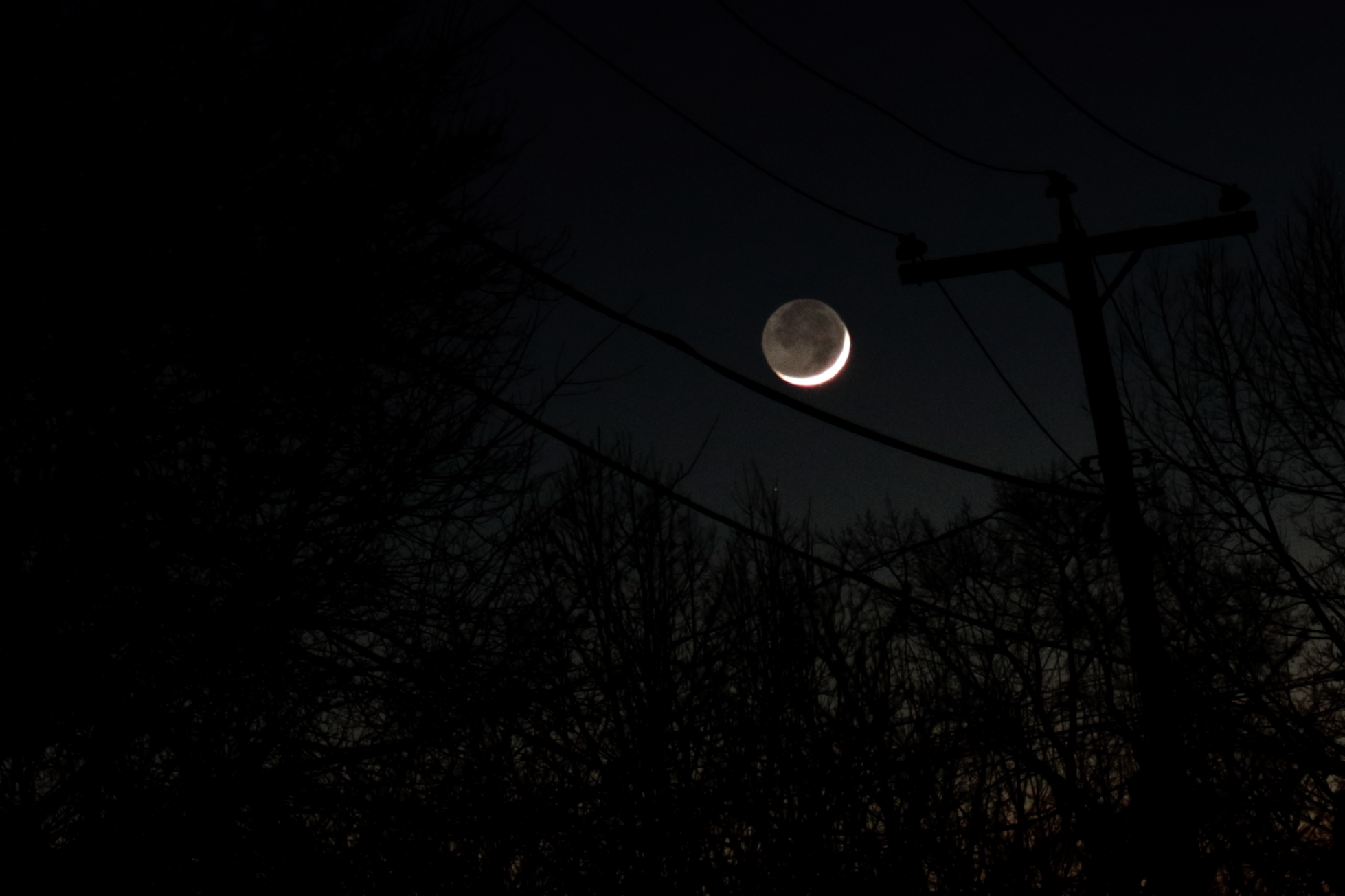
Before going in, a few more attempts were made to capture Mars on video, since it had moved up from the horizon into better atmospheric conditions. As I was packing up, my Apple Watch showed that the Moon had recently risen. Walking around my property, I found a spot that showed it just peaking above the horizon. Seeing the Moon at this early morning hour was a perspective that I have seen few times before. Seeing the Moon at this hour with the waning crescent portion of it visible gave me a new perspective on a familiar sight.
4:45 AM to 11:00 AM
Sleep…








 Arrival: Madisonville, TN

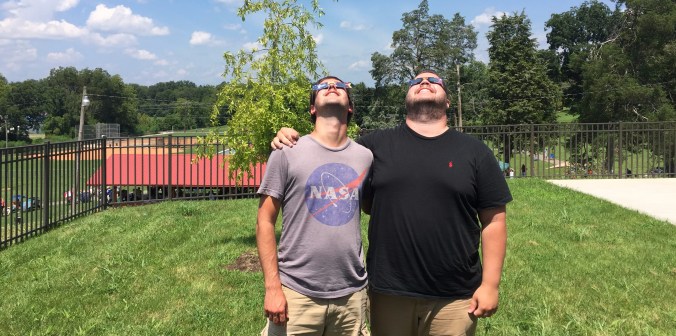 As the time approached, we began to look up at the sun wearing our ISO rated solar glasses, and right on schedule, a sliver of the Moon was visible blocking the extreme upper right corner of the Sun. This gradually grew as the minutes passed. Before long, a third and then half of the Sun was blocked, giving it the appearance of a crescent Moon. The sky very gradually grew darker, particularly at 20 minutes out from totality. The shadows of our bodies and hands were different, almost appearing soft and out of focus. 10 minutes or so out from totality, the birds began to chirp, and at 5 minutes out, crickets began to sing. The temperature appeared to be cooler, but it was mainly due to less radiant Sun hitting our skin. The surrounding environment became very similar in appearance to about 30 to 45 minutes after sunset or if a strong storm with cloud cover was overhead. The Sun now appeared as a slight pencil line in the sky. It then disappeared from the view of my solar glasses.
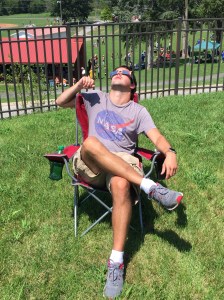 As soon as the Sun disappeared from view, I looked down at my apple watch and the time was exactly 2:32:54 PM. Hearing people cheering, I removed my glasses, looked up and where the Sun had been saw the disc of the Moon completely blocking out the Sun. There was a soft glow coming out from it’s sides and what appeared to be the corona spanning out much farther than I had anticipated. I started my stop watch a few seconds late so I could time when the totality would end. Looking around, there was an eerie 360 degree glow on the horizon appearing as though a sunset was occurring all around us. Venus and Regulus were the most visible stars to appear in the sky, with Venus off to the right and Regulus barely visible just off to the left of the Moon. The time passed quickly, and I looked down at my watch realizing we were coming up on the end of totality. I put on my glasses anticipating the Sun returning and at that time heard someone shout out “The Diamond!” I pulled down my glasses looked up briefly and saw a beautifully bright arc of light appear in the extreme upper right hand corner of the Moon’s disc. It appeared as though God had turned a bright floodlight on in that corner of the Moon. I was startled by this, not quite sure if it was safe for me to see and quickly brought up my glasses and began to see the sliver of the crescent Sun return!