Testing the Waters of Galaxy Hunting

img_2307-1

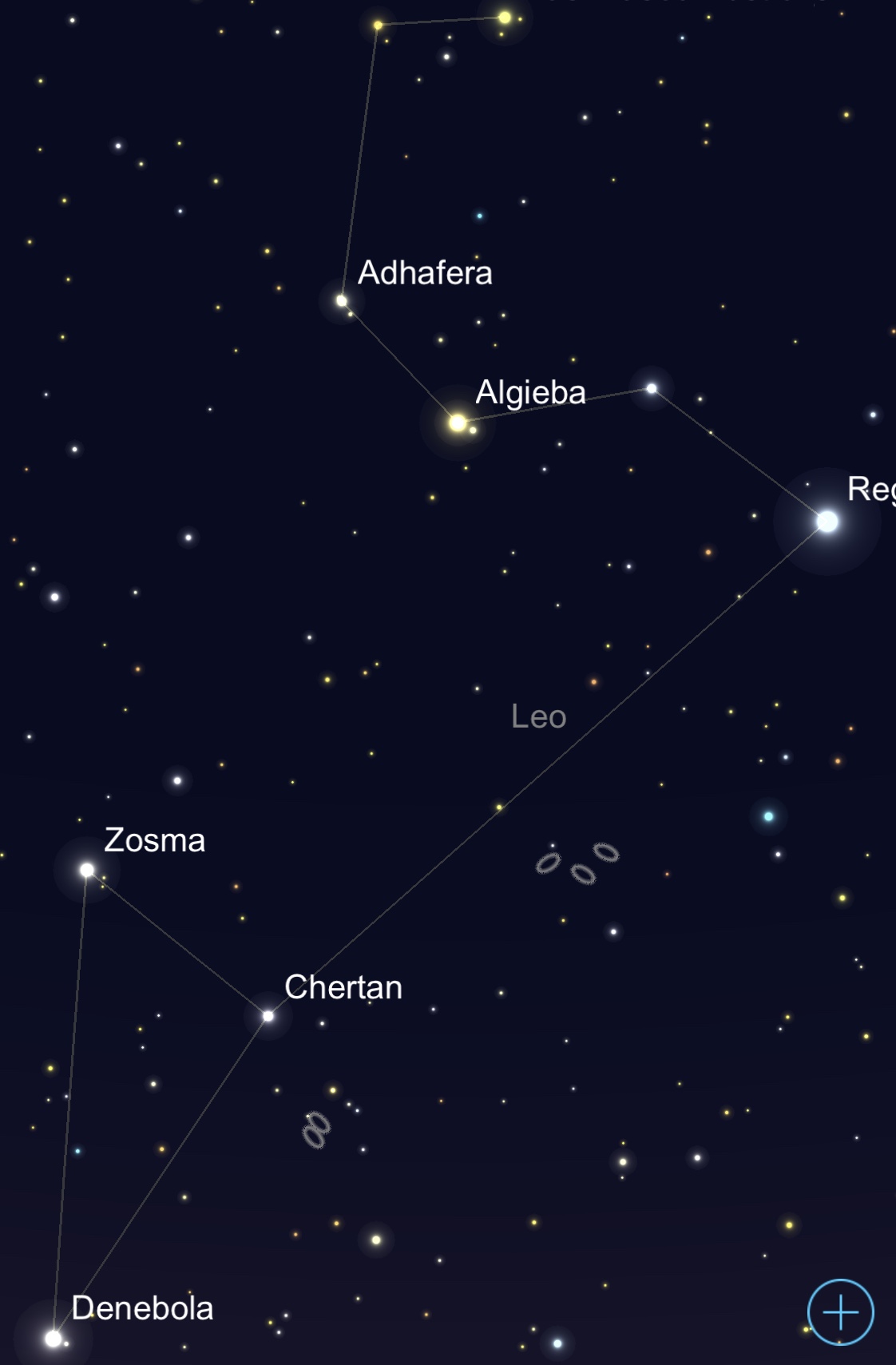
The Constellation Leo

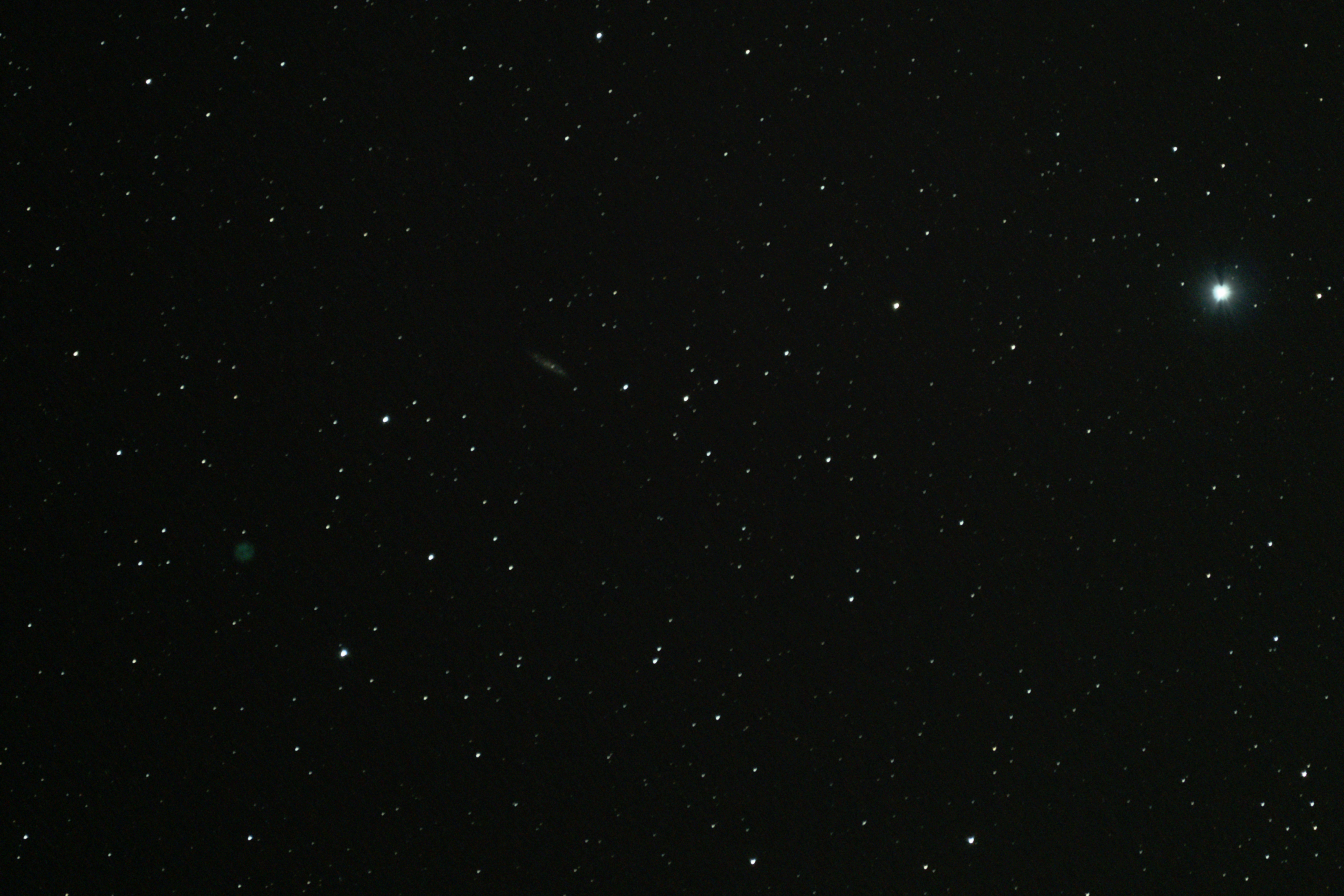
Upon completion of cataloging four constellations Saturday night, I realized that five galaxies needed for my Messier observing book lay in Constellation Leo. Galaxies have been quite frustrating from the confines of suburban skies. Yet, with a steady atmosphere and the Moon yet to rise, I thought an attempt at these wouldn’t hurt.

Star jumping from Chertan over to M65 and M66 left me pleasantly surprised as these two galaxies appeared prominently through my 8 in. dobsonian at 48x magnification. Being able to view these at +8.91 and +9.16 magnitudes excited me at the potential to observe other galaxies, from my location, in the Messier catalog. 

This led me to test the limits of observing magnitudes even further. I star jumped, with much more difficulty, to M95, M96 and M105. Of these three objects, M96 appeared fairly  easily as +9.13. I used it as the central point to verify the locations of M95 and M105. Of these three M95 at +9.72 was the most difficult to spot, pushing the upper limits of what I could view.

A few things helped with observations this evening:
#1: My eyes were dark adapted fairly well for a suburban neighborhood. 
#2: It was an exceptionally clear and steady night with seeing conditions being very good and transparency at a level 6. 

Up next for the Messier catalog will hopefully be 5 galaxies and the Owl Nebula located in Ursa Major.


Photographing The 2019 Total Lunar Eclipse

On a frigid night of 16 degree temperatures, I set up my telescope and DSLR to experience and document the 2019 Total Lunar Eclipse. Having just purchased a refurbished Canon 55-250mm f/5.6 lens, this was a prime opportunity to test out its abilities. Attaching the iPhone X to the telescope allowed me to stream various parts of the eclipse for others (mainly my students) to watch.

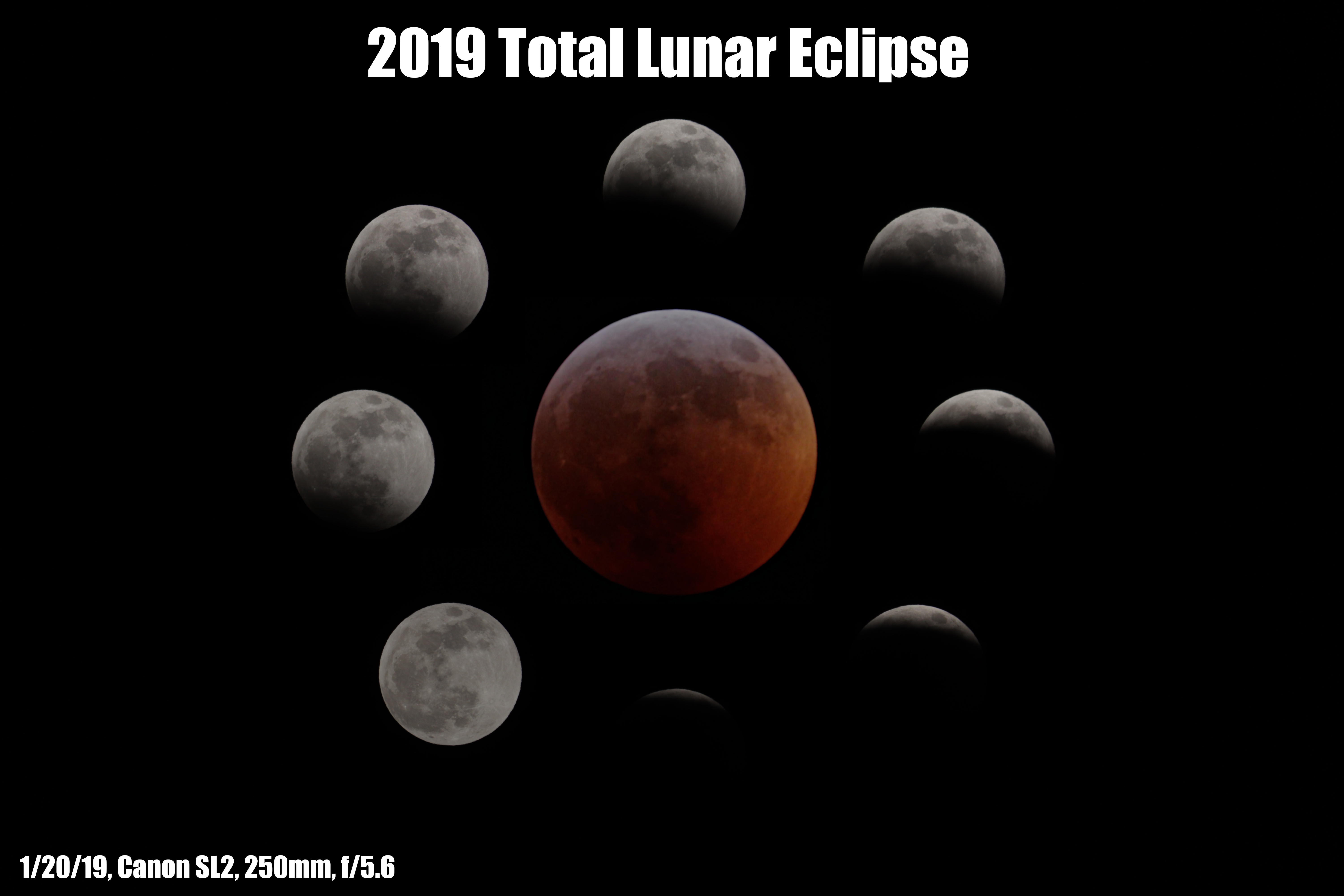
While that was going on, I manually focused the DSLR on the Moon at 250mm and snapped a couple dozen pictures from the beginning of the eclipse through totality. What began as a slowly creeping shadow across the lunar surface morphed into a dim red glow as the Moon moved into totality. As the Moon continued to dim the shutter speed and ISO were continuously adjusted to compensate. Shutter speeds varied from 1/1000 to 1 sec and ISO ranged from 100 to 800 from Full Moon to the dimmest point of totality. Through my excitement, I had forgotten how cold it was and started to feel a tingling pain in my toes that made me quickly call the evening to a close a little after midnight.

The next day, I began work on the following sequence of shots taken during the Lunar Eclipse. The image of the Blood Moon was doubled in size through editing and this collection of shots was put together using GIMP 2.10.

2019 Total Lunar Eclipse

Expanding My Observing Programs

Last year, I wrote about my first steps into the world of Astronomical League Observing Programs. Having recently completed the “Lunar” program, I decided to expand my observing books to also include:

“Northern Skies Constellation Program”
I am not very good with names. Be it people or stars. This observing program should help to familiarize myself with the constellations and some of the major stars that form them. I particularly enjoy the observing programs that require some sketching, and after 39 Northern Constellations, I should be a good bit better at recognizing the night time sky. To assist me in these observations, I have purchased a “Planisphere”. As a child, I could never match these correctly with the stars. I’m hoping for better results in my 30’s.

“Galileo Observing Program”
Retracing the history and observations of the man who birthed the hobby is the purpose of this observing program. From the Moon to the Sun and the planets, the goal is to recreate the observations of Galileo. This one involves a variety of challenges that I am greatly looking forward too.

“The Observing Books”

The Summer Portrait is Complete

Tonight, I completed my imaging goal for the summer. Mars, Jupiter and Saturn have all been filmed, stacked and processed using a DSLR camera. All three of these images were captured at f/11.8 which means the images above are at accurate scale to each other as viewed through the Orion Xt8i. Mars was the last holdout, with the dust storm washing out most detail during my earlier attempts in late July. For comparison, below are my previous images of these three planets taken with an iPhone 6 back in 2016.


A Late Night Out

June 7/8, 2018: Those Summer Nights
Summer is not a favorable season for amateur astronomy. The nights are short, dew sneaks up on you and the insects are annoying. On this night, the skies were clear, the dew point was reasonable and the insects were not biting, at least not that bad. With the moon not rising until 2:45 AM, it was a wonderful opportunity to work through some deep-sky objects on my Messier List.

10:45 PM to Midnight
After allowing the telescope to cool for an hour, the evening began with M13-Hercules, a favorite of mine since my first observations of it in 2010. It is one of the most impressive views in the night sky and a treat to show off to family and friends. What starts off as a dense blurry core is peeled away to reveal finer levels of detail at medium and high magnifications, where thousands of stars become visible. Objects such as this truly reveal to me the glory of God’s creation. My success rate at finding and being impressed by other globulars tonight was hit and miss. While the small but impressive M92 was easy to find, the dimmer M107 was nowhere to be seen due to light pollution near the horizon. Most of the other globular clusters early this evening were of little detail, including M19, M80 and M9.

Midnight to 12:15 AM
Lauren came out to take a look at Hercules and Saturn. While she was impressed by the fine detail of Hercules, her favorite sight is always Saturn. She has a better eye for fine detail on the planets than myself and easily picked up the Cassini division and a dim cloud band across the middle of the planet.

1:00 AM to 1:30 AM
The hunt for globular and open clusters continued after a brief hiatus. M22 was a surprisingly impressive globular cluster with fine detail in its core showing up at 96x and 200x magnification. Hopping over just a couple degrees was the smaller and less defined M28. Switching to an open cluster, M25 was just a stone’s throw away from Saturn with a pretty collection of stars shown at lower magnifications. While M54 was difficult to find due to light pollution near the horizon, M70 was impossible. What awaited next was the most pleasant surprise of the evening, M11–The Wild Duck Cluster was a beautifully dense and sharply detailed open cluster. It could easily be mistaken for a globular cluster because of the density of the core. At 96x and 200x magnification, it revealed some fine details including one star shining brightly in the upper center of the core.

1:30 AM to 2:00 AM
Shifting gears to some things a bit closer home, Jupiter, Saturn and Mars were on display throughout most of this evening. Atmospheric conditions were ideal with fairly cool temperatures and no wind. Of the three, Jupiter in particular was stunning in it’s sharpness and clarity with three of its moons Io, Ganymede and Callisto in a tight triangular formation. I Hooked my iPhone up to the telescope and took some videos of the planets.

Here is some of the video I shot that is posted on my YouTube Channel.

The 1080p 60 FPS footage was sent to Registax 6 to enhance the sharpness. Then the color and contrast were enhanced in Adobe Premiere Elements 6 to create the following image of Saturn at 1200x magnification.

3:15 AM to 4:00 AM
With that, the night was done–or so I thought! Having brought in all of my equipment, I realized I was just three Messier objects shy of hitting the halfway point. I looked at the clock and decided to lug everything back out for three more objects. The final three Messier objects began with M73, an open cluster with a simplistic four star pattern. It took a while to verify its location, with observations at higher magnifications revealing more of the stars in its formation. One wonders why an object like this was included in the Messier list to begin with. Second to last was M15, a small yet surprisingly bright globular cluster with an impressive core which revealed some structural details at higher magnifications. The night officially ended with the anticlimactic M2, revealing itself only as a small blurry globular cluster with some minor fine detail at 200x magnification.

4:00 AM to 4:15 AM
Before going in, a few more attempts were made to capture Mars on video, since it had moved up from the horizon into better atmospheric conditions. As I was packing up, my Apple Watch showed that the Moon had recently risen. Walking around my property, I found a spot that showed it just peaking above the horizon. Seeing the Moon at this early morning hour was a perspective that I have seen few times before. Seeing the Moon at this hour with the waning crescent portion of it visible gave me a new perspective on a familiar sight.

4:45 AM to 11:00 AM
Sleep…

Year One of the Messier List

A year after beginning the Astronomical League’s Messier Observing Program,  I have completed half of the list. With 55 objects down and 55 to go, it has been a wonderful year of deep-sky observations. I anticipate the second half to go a bit slower than the first. Two factors will contribute to this. The first is light pollution from my primary observing location. I have run into difficulty finding galaxies and globular clusters that are dimmer than +9.00 magnitude. The second is my wife and I expecting our first child in July. Between light pollution and a little one, it will definitely take me longer to complete the second half of this list.

Objects Observed:

M1, M2, M3, M5, M9, M10, M11, M12, M13, M14, M15, M19, M22, M25, M28, M31, M32, M34, M35, M36, M37, M38, M39, M40, M41, M42, M43, M44, M45, M46, M47, M48, M50, M51, M52, M53, M54, M56, M57, M63, M64, M67, M73, M76, M77, M78, M79, M80, M81, M82, M92, M93, M94, M103, M110

Favorite Objects:

  • M11-Wild Duck Cluster
  • M13-Hercules Cluster
  • M31-Andromeda Galaxy
  • M37-Open Cluster
  • M42-Orion Nebula
  • M45-Pleiades
  • M57-Ring Nebula
  • M67-Open cluster
  • M76-Little Dumbbell Nebula
  • M81-Bode’s Nebulae
  • M82-Bode’s Nebula

A Big Dent in the Messier List

GQ’s 2018 Man of the Year

An Unexpected Late Night:
Being a teacher has its benefits. Snow days are definitely one of them. The call came in around 6:00 pm; school would be closed on Friday. I jumped up and ran out my telescope to cool down for an evening of observing. While that was occurring, I loaded up SkySafari 6 to plan out what Messier targets I would hunt down on this crystal clear and moonless night. What followed was a wonderful, if a bit cold, late night.

Early Evening: 6:00 pm to 6:30 pm
After setting up the telescope, I took the DSLR to get some images of the waxing crescent moon about to set near the horizon. Messing around with the settings, I attempted to capture the “Old Moon in the New Moon’s Cradle”, or the Earth’s shine reflecting off the dark surface of the Moon.

Old Moon in the New Moon's Arms

Earthshine off of the Crescent Moon

A Frustrating Start to the Night: 8:00 pm to 8:30 pm
The first three targets of the night were M74, M33 and M77. Of those three, I was only able to view M77, due to light pollution and the low surface brightness of M33 and M74. I will have to find a darker sky location to view them in the future.

Later in the Night: 11:00 pm to 12:00 amimg_4094-e1516568784442.png
Heading back out, I was met with temperatures in the low 30’s and a crystal clear evening. The telescope had fully cooled and there was little to no wind. I began by focusing on some open clusters in the Constellation Auriga that were a bit difficult to find. At first, I mistook M36 for M38. Silly Me! Once I sorted them out, M36 had interesting star formations that shoot out in straight lines. Moving down to M37, I witnessed a nice dense star cluster that was best viewed through my low power 2 in. eyepiece. The Starflish Cluster, M38 was an interesting site and clearly gets its name from its star pattern. Jumping over to M1, the Crab Nebula is always a disappointment to me, appearing as a dim blob in space. M35 was nothing of distinction but was easy to find from the Crab Nebula, and I caught a glimpse of the small globular M79 before loosing it to the treeline and more heavy light pollution. After this, I took a few shots of the Auriga Constellation to see if my DSLR could pick of any of the star clusters I had just viewed and went inside to warm up.

Early Morning: 1:00 am to 2:30 am
After an hour of warming my feet, it was back outside for another hour of observing. While inside, I decided to focus my attention on some old favorites to end the night. Back outside, I first viewed M44, the Beehive Cluster, which has some beautiful triangle patterns. I was very impressed by M67. It appeared to be layered in terms of its detail, with the brightest stars coming to the forefront at lower magnification and a somewhat cloudy layer of dimmer stars showing up at higher magnifications. M48 wasn’t much in terms of detail but was easy to find. Finally, I ended the night of with two old favorites, M81 and M82. I remember the first time I viewed these several years ago. The way in which they float in space together with their odd pairing of shapes and high surface brightness is a wonderful view. With that, I had tracked down 12 more Messier objects with 75 left to go.

One Last Thing:
As I was packing up, I set up the DSLR for my first attempt at a long exposure shot of Polaris. My hope was to show star trails emanating from it. After making sure I was on the right star and setting focus, I set the camera to 55mm, f/5.6, ISO 100 and put the exposure to bulb. After starting the shot, I came back out about 15 minutes later and ended up with the following image:

IMG_0896

Following some post processing the next day in Canon’s Digital Photo Professional 4, I ended up with this final image:

IMG_08965