With the addition of the Celestron EclipSmart Solar Telescope, I will begin studying the Sun. Look for a written or video review coming soon… 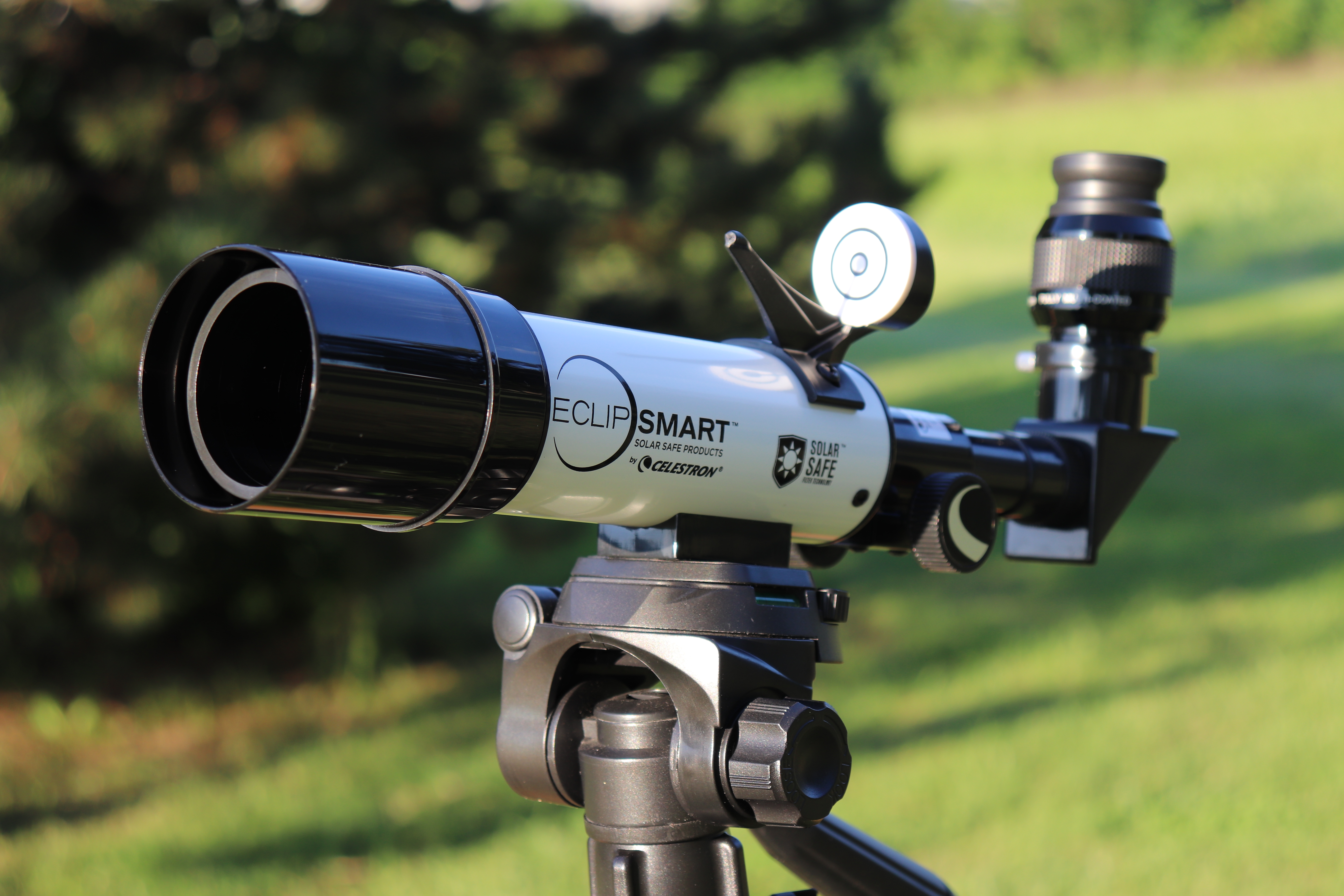
Lauren practices safe solar viewing for herself and our daughter.
What a wonderful mother!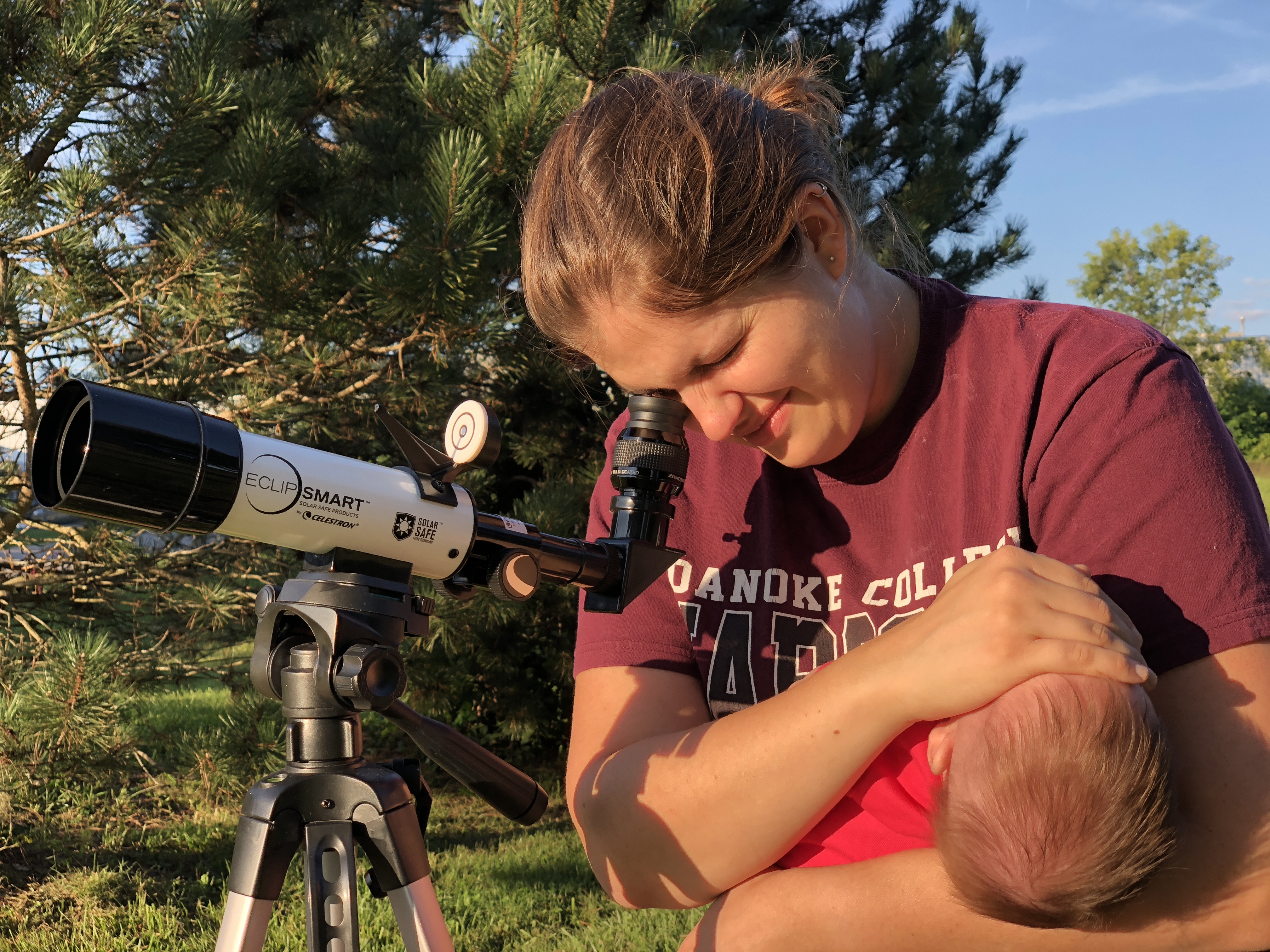
With the addition of the Celestron EclipSmart Solar Telescope, I will begin studying the Sun. Look for a written or video review coming soon…
Lauren practices safe solar viewing for herself and our daughter.
What a wonderful mother!
GQ’s 2018 Man of the Year
An Unexpected Late Night:
Being a teacher has its benefits. Snow days are definitely one of them. The call came in around 6:00 pm; school would be closed on Friday. I jumped up and ran out my telescope to cool down for an evening of observing. While that was occurring, I loaded up SkySafari 6 to plan out what Messier targets I would hunt down on this crystal clear and moonless night. What followed was a wonderful, if a bit cold, late night.
Early Evening: 6:00 pm to 6:30 pm
After setting up the telescope, I took the DSLR to get some images of the waxing crescent moon about to set near the horizon. Messing around with the settings, I attempted to capture the “Old Moon in the New Moon’s Cradle”, or the Earth’s shine reflecting off the dark surface of the Moon.
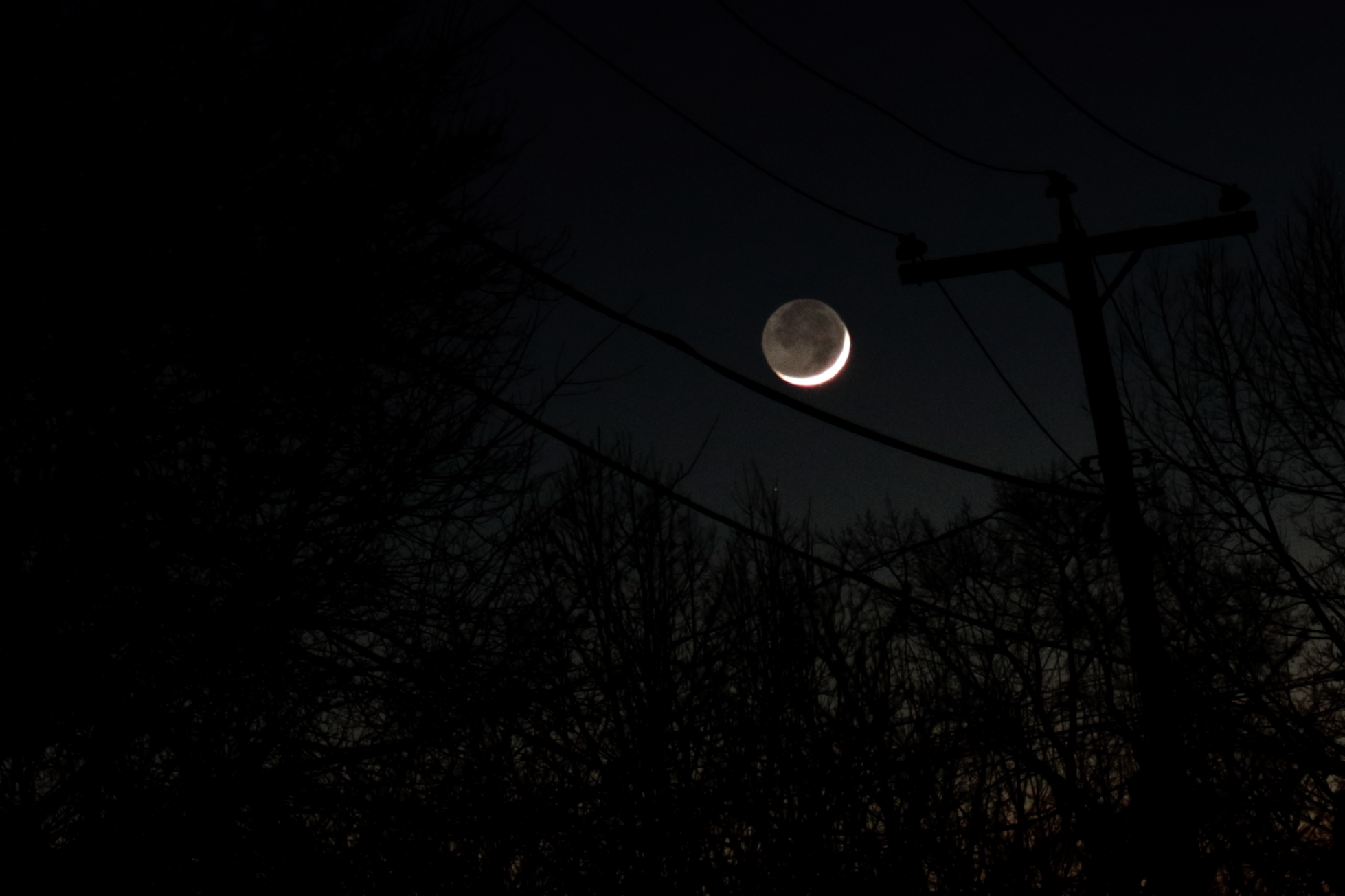
Earthshine off of the Crescent Moon
A Frustrating Start to the Night: 8:00 pm to 8:30 pm
The first three targets of the night were M74, M33 and M77. Of those three, I was only able to view M77, due to light pollution and the low surface brightness of M33 and M74. I will have to find a darker sky location to view them in the future.
Later in the Night: 11:00 pm to 12:00 am
Heading back out, I was met with temperatures in the low 30’s and a crystal clear evening. The telescope had fully cooled and there was little to no wind. I began by focusing on some open clusters in the Constellation Auriga that were a bit difficult to find. At first, I mistook M36 for M38. Silly Me! Once I sorted them out, M36 had interesting star formations that shoot out in straight lines. Moving down to M37, I witnessed a nice dense star cluster that was best viewed through my low power 2 in. eyepiece. The Starflish Cluster, M38 was an interesting site and clearly gets its name from its star pattern. Jumping over to M1, the Crab Nebula is always a disappointment to me, appearing as a dim blob in space. M35 was nothing of distinction but was easy to find from the Crab Nebula, and I caught a glimpse of the small globular M79 before loosing it to the treeline and more heavy light pollution. After this, I took a few shots of the Auriga Constellation to see if my DSLR could pick of any of the star clusters I had just viewed and went inside to warm up.
Early Morning: 1:00 am to 2:30 am
After an hour of warming my feet, it was back outside for another hour of observing. While inside, I decided to focus my attention on some old favorites to end the night. Back outside, I first viewed M44, the Beehive Cluster, which has some beautiful triangle patterns. I was very impressed by M67. It appeared to be layered in terms of its detail, with the brightest stars coming to the forefront at lower magnification and a somewhat cloudy layer of dimmer stars showing up at higher magnifications. M48 wasn’t much in terms of detail but was easy to find. Finally, I ended the night of with two old favorites, M81 and M82. I remember the first time I viewed these several years ago. The way in which they float in space together with their odd pairing of shapes and high surface brightness is a wonderful view. With that, I had tracked down 12 more Messier objects with 75 left to go.
One Last Thing:
As I was packing up, I set up the DSLR for my first attempt at a long exposure shot of Polaris. My hope was to show star trails emanating from it. After making sure I was on the right star and setting focus, I set the camera to 55mm, f/5.6, ISO 100 and put the exposure to bulb. After starting the shot, I came back out about 15 minutes later and ended up with the following image:
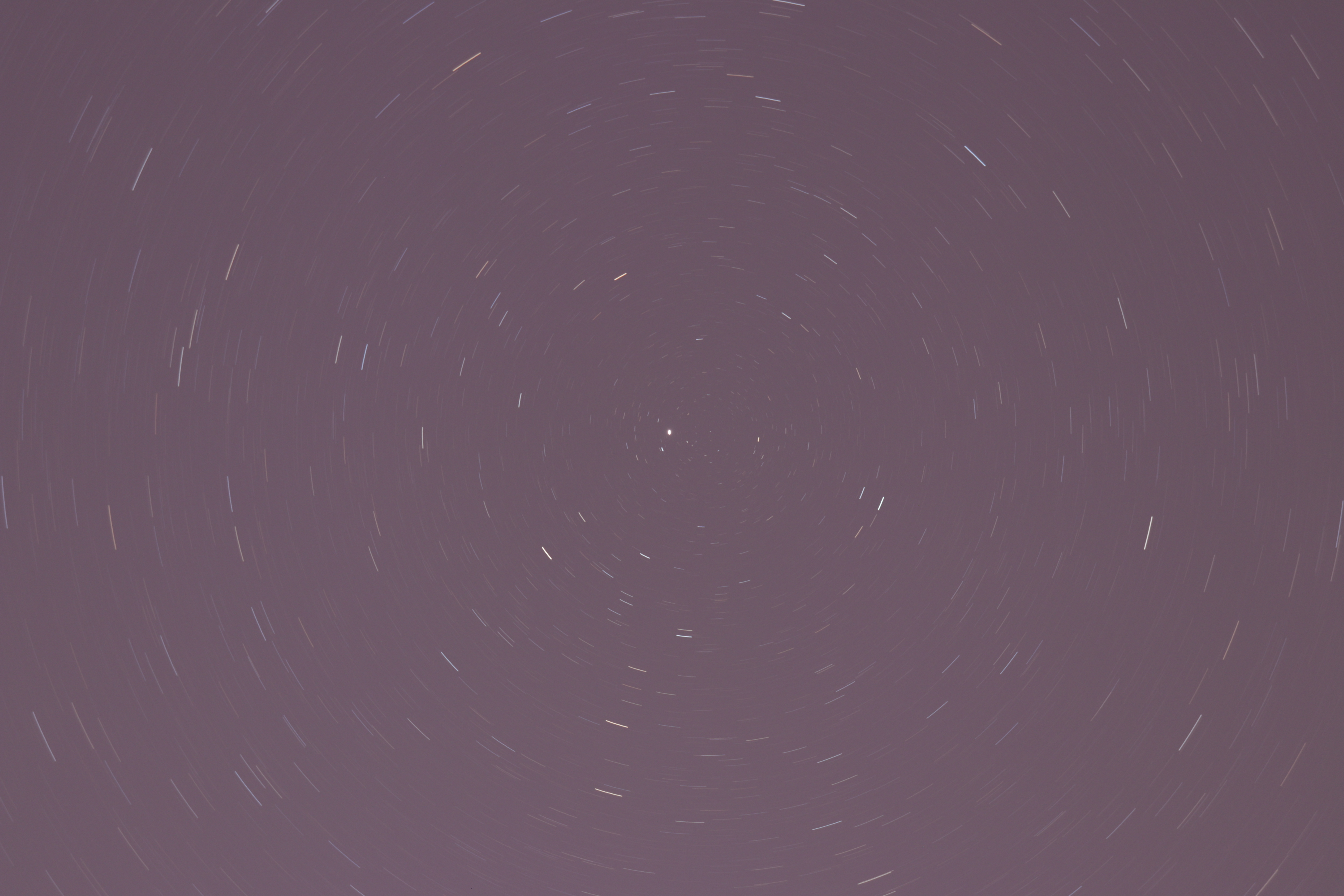
Following some post processing the next day in Canon’s Digital Photo Professional 4, I ended up with this final image:

Departure:
August 20, 2017
9:30 PM
The journey began with the arrival of my friend, Cody, who was joining me on this pilgrimage to totality. We left my house and hopped on interstate 81, where we were greeted by a car from New Jersey flipping off a car driving slowly in the passing lane. The number of out of state and out of country plates heading south on 81 was a reminder of how popular and unique this event was.
 Arrival: Madisonville, TN
August 21, 2017
2:35 AM
We chose Madisonville due first and foremost to its central location for totality and its low population and relative distance from the nearest interstate. Our hope was that these combinations would make it a little less cramped and easier to get out of than other surrounding areas. Our hotel was my nice and still fairly new Mazda 3 Hatchback parked at a Walmart. Other than a group of teenagers waking us around four in the morning, we slept alright considering it was a car parked at a Walmart.
As night turned to day, we awoke and drove to a Hardee’s for a nice breakfast with the locals. Driving through the cute downtown of Madinsonville, a sign said that the local library would be throwing an observing event. After parking at the library, Cody and I walked through downtown and enjoyed some coffee at a small shop.


By this time, a good number of people had started to arrive in Madisonville. Our chosen spot at the library ended up connecting us with some interesting couples, two of which had witnessed totality on separate occasions and one who had brought a solar telescope for observing the event prior to and after totality.
Start of Partial Eclipse:
1:04:16 PM
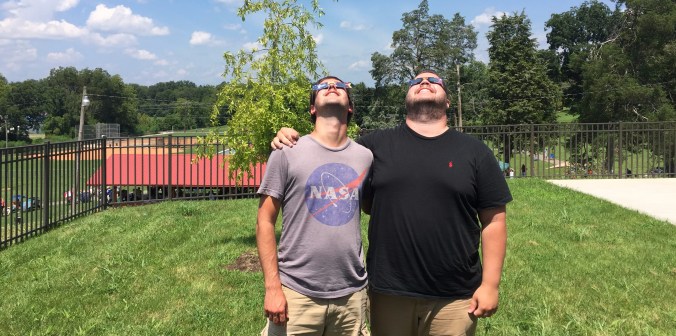 As the time approached, we began to look up at the sun wearing our ISO rated solar glasses, and right on schedule, a sliver of the Moon was visible blocking the extreme upper right corner of the Sun. This gradually grew as the minutes passed. Before long, a third and then half of the Sun was blocked, giving it the appearance of a crescent Moon. The sky very gradually grew darker, particularly at 20 minutes out from totality. The shadows of our bodies and hands were different, almost appearing soft and out of focus. 10 minutes or so out from totality, the birds began to chirp, and at 5 minutes out, crickets began to sing. The temperature appeared to be cooler, but it was mainly due to less radiant Sun hitting our skin. The surrounding environment became very similar in appearance to about 30 to 45 minutes after sunset or if a strong storm with cloud cover was overhead. The Sun now appeared as a slight pencil line in the sky. It then disappeared from the view of my solar glasses.
Totality:
2:32:54 PM to 2:35:32 PM
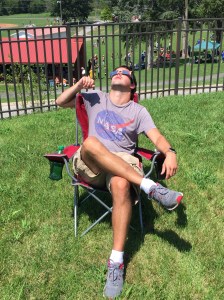 As soon as the Sun disappeared from view, I looked down at my apple watch and the time was exactly 2:32:54 PM. Hearing people cheering, I removed my glasses, looked up and where the Sun had been saw the disc of the Moon completely blocking out the Sun. There was a soft glow coming out from it’s sides and what appeared to be the corona spanning out much farther than I had anticipated. I started my stop watch a few seconds late so I could time when the totality would end. Looking around, there was an eerie 360 degree glow on the horizon appearing as though a sunset was occurring all around us. Venus and Regulus were the most visible stars to appear in the sky, with Venus off to the right and Regulus barely visible just off to the left of the Moon. The time passed quickly, and I looked down at my watch realizing we were coming up on the end of totality. I put on my glasses anticipating the Sun returning and at that time heard someone shout out “The Diamond!” I pulled down my glasses looked up briefly and saw a beautifully bright arc of light appear in the extreme upper right hand corner of the Moon’s disc. It appeared as though God had turned a bright floodlight on in that corner of the Moon. I was startled by this, not quite sure if it was safe for me to see and quickly brought up my glasses and began to see the sliver of the crescent Sun return!
The Voyage Home:
2:45 PM to 10:30 PM
It was an incredible event to experience, and the trip home was not as busy as we had feared with traffic. Next time, though, I think I’ll try to book a hotel instead of a Walmart.
On Christmas Eve of 2010, my wife Lauren and I had been engaged for a little under an hour when she presented me with the book “Lost Moon: The Perilous Voyage of Apollo 13”. As I scanned through it, I came across a signature on the authors page that I did not expect.

Jim Lovell is my favorite astronaut–yes, I have a favorite astronaut. A veteran of the Gemini and Apollo programs, known most famously for Apollo 13. The co-author of that book was a man by the name of Jeffrey Klugger who is a senior writer for Time Magazine. While browsing Amazon.com a few weeks ago, I noticed that he had a new book out detailing the voyage of another mission involving Jim Lovell, Apollo 8, man’s first trip to the Moon.
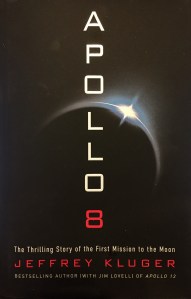
The story begins with Frank Borman being notified that his training for an earth orbital flight on Apollo 9 was being altered to a lunar orbital flight that would take place during Apollo 8. I had come across Frank Borman’s name and missions in other Apollo books such as Andrew Chaikin’s “A Man on the Moon”, but I had little knowledge of the backstory or personality of this veteran of the Gemini and Apollo programs. He along with Jim Lovell and Bill Anders are each introduced through details of their career and family life leading up to Apollo 8.
I was presently surprised with how much time the book spent on supporting events and individuals leading up to Apollo 8. The history of the National Advisory Committee of Aeronautics and its transformation into NASA takes up a good portion of the early book. Back stories for NASA officials such as Chris Kraft, Deke Slayton and Gene Kranz are delved into more than I expected. The first half of the book is a nice, all be it brief, history lesson on the formation of NACA/NASA and the successes and difficulties of the Mercury and Gemini missions that preceded Apollo.
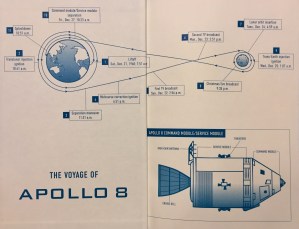
With the tragic fire of Apollo 1, that cost the lives of Gus Grissom, Ed White and Roger Chaffee, Kruger turns his attention to the story of Apollo and the almost insurmountable task of redesigning the capsule and putting a man on the moon before the decade was out. From this point on, the story moves at a nice pace and quickly moves to the decision to launch Apollo 8 as a lunar orbiting mission. I was inspired by the tenacity and boldness of this decision. Today, I feel the bold moves in space are being made in the private sector, with the Space X’s of the world. Apollo 8 is a nice reminder of how daring NASA was in the 60’s and 70’s with it’s lunar program.

Apollo 8 being moved out to the launch pad.
With the first successful launch of a Saturn V Rocket carrying a crew, a feat in an of itself, Apollo 8 was off to the Moon. By all intents and purposes it was a by the book mission. There were no major mishaps, system crashes or critical failures on their six day mission. This does not mean that the story is any less interesting. Going to the Moon is never a forgone conclusion, particularly for the first time. It took a tremendous amount of planning, testing and training to make this mission a success. Once the Lunar Orbit Insertion burn was completed, the Apollo craft fell into a stable lunar orbit. The crew became the first humans to see the far-side of the Moon with their own eyes. What they would witness next would become one of the most powerful photographs ever taken.
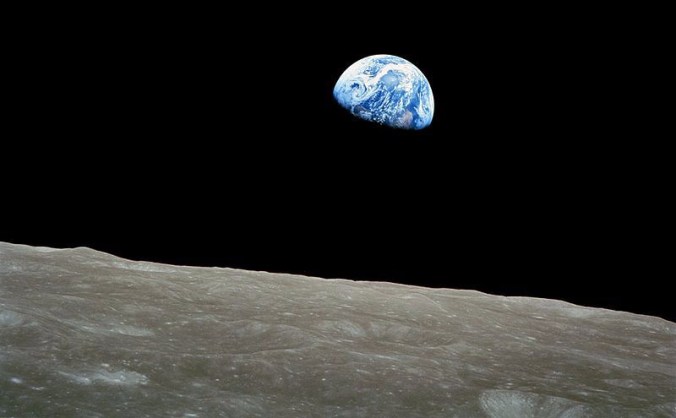
Earth Rise: Photo by Bill Anders
Later into the mission, Frank Borman looked out the window of his Apollo 8 capsule and was amazed by what he saw:
“Oh, my God! Look at that picture over there! Here’s the Earth coming up. Wow, is that pretty!”
While Frank Borman took the first black and white image of this event, it was Bill Anders, who was in charge of the mission’s photography, who snagged the color photo posted above that would go on to become one of the most acclaimed and viewed pictures in the world. On Christmas Eve of 1968, Apollo 8 took some time from their busy schedule to host a live televised broadcast. They were given little direction from NASA regarding what to do so they each went around and discussed what had impressed them the most about the Moon that they had been orbiting for the past several hours. The broadcast would end however with a touching message as each of the astronauts proceeded to read from the book of Genesis.
Excerpts from the Apollo 8 Christmas Eve Message:
Bill Anders:
“We are now approaching lunar sunrise, and for all the people back on Earth, the crew of Apollo 8 has a message that we would like to send to you.”
“In the beginning God created the heaven and the earth….”Jim Lovell:
“…And God called the light Day, and the darkness he called Night. And the evening and the morning were the first day…”Frank Borman:
“…And God called the dry land Earth; and the gathering together of the waters called he Seas: and God saw that it was good.”
“And from the crew of Apollo 8, we close with good night, good luck, a Merry Christmas – and God bless all of you, all of you on the good Earth.”
It is easy to underestimate the importance of Apollo 8, knowing the outcome of the space race and the successful landing of Apollo 11 that would follow. But, for those who were living through these events during the tumultuous year of 1968, the Christmas voyage of Apollo 8 surely stands out as a historic milestone that inspired and captivated a world desperately in need of a reminder of how precious our planet is. Jeffrey Kluger’s book “Apollo 8: The Thrilling Story of the First Mission to the Moon” brings this event to life in an enjoyable and accessible way.
This past Sunday, February 26, 2017, a fellow member of my local astronomy club , Bert Herald, invited me over for some observing. Bert has recently purchased an impressive Celestron Cassegrain telescope and tracking mount to do astrophotography.


He has just recently moved from afocal imagining, using an iPhone, to the big leagues of DSLR astrophotograpy. The evening started with a complicated and sometimes frustrating polar/5 star alignment which gave me a greater appreciation for the complexity of these advanced telescopes. After some initial difficulties with alignment, later in the evening Bert was able to get some nice exposures of NGC 1983, the Running Man Nebula. He described overcoming some difficulties with the tracking system for this observing session and the process of capturing the nebula:
Tracking continued to suffer even after a second round of alignment! But it was good enough to capture a set of 5 30 sec exposures. I stacked them and briefly edited…
The result of his efforts is an impressive image of NGC 1983, particularly for someone new to advanced astrophotography.
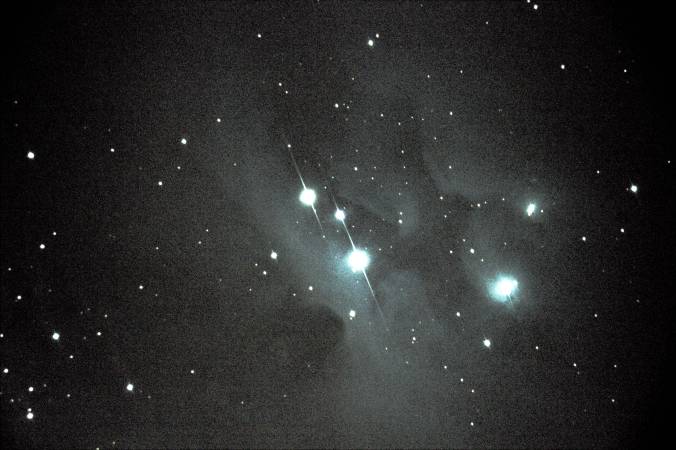
Bert Herald: Running Man Nebula, February 26, 2017
In the 76 year history of Late Night Astronomy, the editorial board has never made an endorsement in a presidential election. That ends tonight. After two debates and over a year of campaigning, it is obvious that only one candidate has the judgment, temperament and stamina to be President of the United States. Through these criteria and after great deliberation, we are throwing our support behind “Giant Meteor 2016”.

Only “Giant Meteor 2016” has the ability to wipe out the national debt and take America back to the glory days of our early republic. While some in the mainstream media will attack “Giant Meteor 2016” for bringing instant death to millions and a slow death to tens of millions more, we simply find these results preferable to a Trump or Clinton presidency.
In fact, a recent poll found that 13 percent of Americans prefer “Giant Meteor 2016” when given the option.
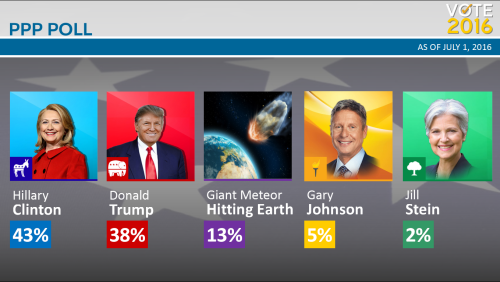
If you’re tired of politics as usual and want something that will truly shake up the system, we urge you to vote for “Giant Meteor 2016” this November. Our children’s future depends on it!
It’s been a while since I’ve updated the photos hanging in the “Astronomy Corner” of the basement. With my recent attempts at planetary and lunar imaging, I felt it was time to change up some of the photos displayed alongside the telescope. Without further ado, here are the prints along with a look at the aforementioned “Astronomy Corner”.
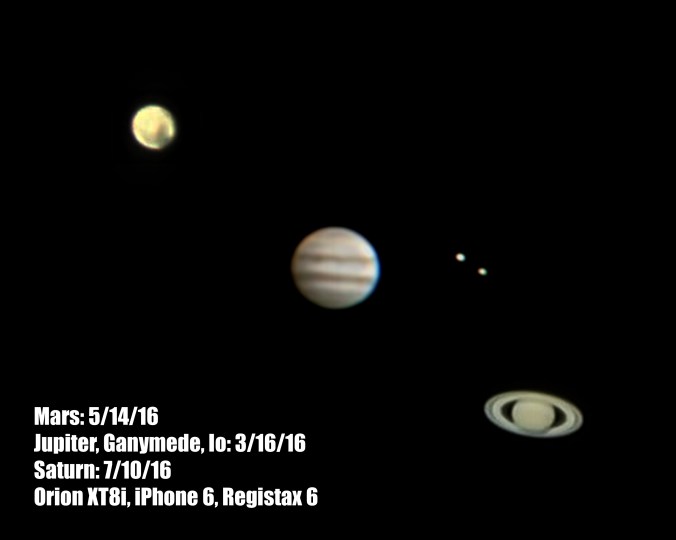
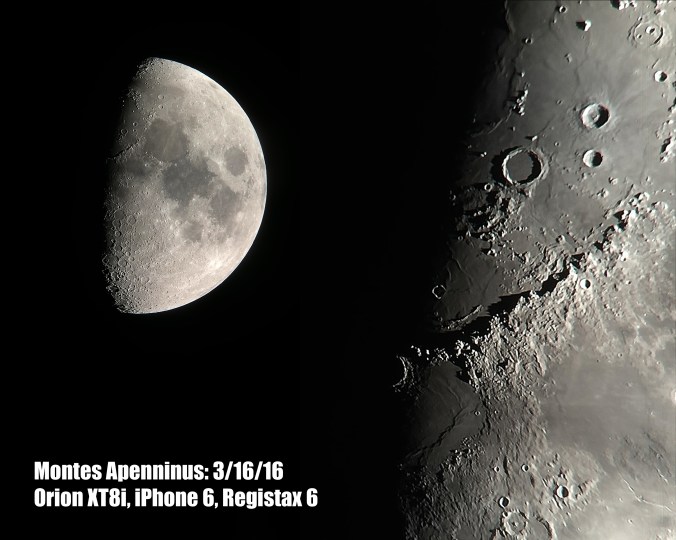
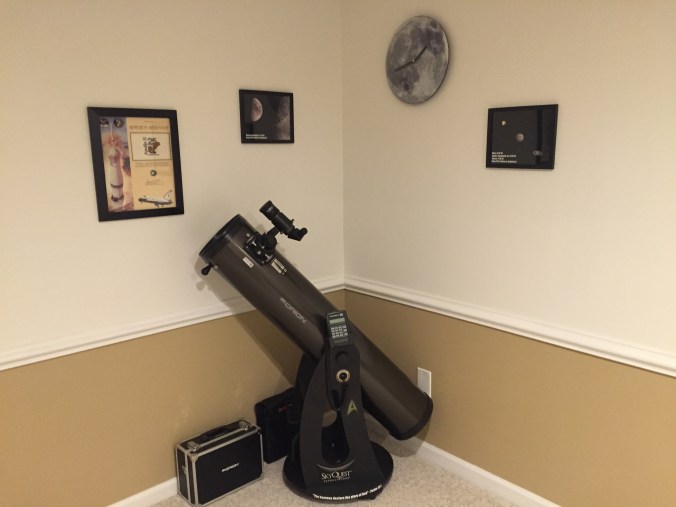
The summer months can be a tricky time for observing. The nights are short, the weather is erratic and dew starts to build up on the telescope as soon as the serious observing begins. Nights that are clear, calm and cool are rare to come by and should be taken advantage of. I did just that on the night of July 10-11 from 10:45 pm to 1:30 am.
Starting with the Solar System
Mars:
Viewing conditions were difficult, looking through the turbulent summer atmosphere, views of Mars were less impressive at high magnifications. Also, Mars continues to move farther from us, having made its closest approach to Earth on May 30, 2016 at a distance of 47 million miles, making surface detail harder to make out each night.
Saturn:
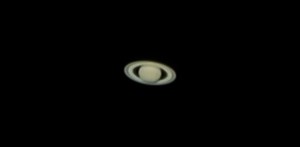
One of the highlights of the night, as usual, came from Saturn. With the Cassini Division in full view, this planet always tends to be more forgiving of rough atmospheric conditions, particularly compared to Mars and Jupiter. I was able to try out my new iPhone adapter with the telescope and after some initial alignment difficulties over the eyepiece was able to get a short video.
After being processed through Registax 6 and Adobe Premiere Elements, this image was the final product.
Into Deep Space
The main targets of the evening were Deep Sky Objects. I’ve been chipping away at the Messier List for about six years. These 110 objects are considered some of the best to view and most are attainable with affordable binoculars and telescopes if you are in an area with low light pollution.
Globular Clusters:
Of all the views from this night, the globular clusters were the most difficult to find and disappointing to see. These dense collection of stars were partially drowned out by light pollution and the Moon that had yet to fully set. M80 and M92 were two new ones that I was able to mark off my list. M13 was an impressive show, even with the viewing conditions working against it. The Hercules Cluster is one of the most impressive globular clusters in the sky. I find it hard to focus the object correctly because of how dense the star field is. Various levels of focus almost seem to bring out new layers of detail.
Open Clusters:
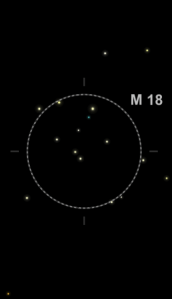 These collections of stars always impress me with their elegance and simplicity. Not nearly as dense and “fuzzy” as globular clusters, open clusters can be difficult to find but rewarding to discover. Take M18 for example, to verify that I had the correct collection of stars, I had to consult my star chart (Sky Safari 4 Plus on my iPhone) that I was in the correct region of the sky. I did this by counting stars and comparing patterns between what was in my eyepiece and what the chart on my app showed. M23, M26 and NGC 6633 rounded out the list of open clusters viewed.
Supernova Remnants:
One of my favorite sights of the summer sky are the five to eight thousand year old supernova remnants of the Eastern and Western Veil Nebula. I wasn’t sure if NGC 6960 and NGC 6995 would show up from my viewing site, but sure enough with the help of an O-III filter they did. The scale of these two objects is an impressive sight and their ghostly outlines are fitting for the remnants of a dead star.
One last Planet
Neptune:
By around 1:30 am, I started to get tired but noticed that there was one planet which had just moved high enough for me to view. Neptune is the farthest planet from the Sun, making it one of the more difficult ones to spot, excluding dwarf planets, sorry Pluto. At 400x magnification, I could make out a faint circular disc with a blueish gray tint. Not bad for something 2.8 Billion Miles away.
Night vision is key to astronomy. On moonless nights when galaxies, nebulae or globular clusters are at the top of your observing list, properly adapted eyes can be as important as the aperture of the telescope for spotting a “faint fuzzy”. The June and July editions of Sky & Telescope each have articles detailing how to adapt a flashlight for astronomy. Inspired by these articles, I decided it was time to put together my own red flashlight. Since red light is more forgiving to the eye when it is dark-adapted, this is the preferred way to light up an area while still keeping most of your night vision. While red flashlights can be found from companies such as Celestron and Orion for fifteen to thirty dollars, I didn’t care much for their designs and decided to build my own.
Step 1:
After a trip to Target and Advanced Auto Parts,
I had an LED Flashlight and Red Tail Light Repair Tape.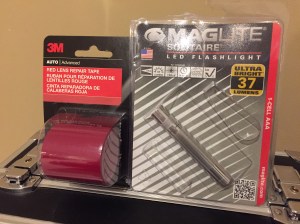
Step 2:
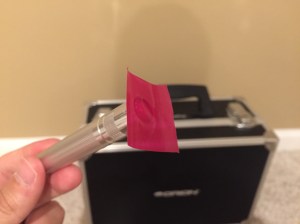
Cutting out a small piece of the red tape, I placed it over the light.
Step 3:
Using a pair of scissors and a sharp knife from “Cutlery Corner”, I trimmed the tape and carefully cut it down to size, only covering the lens.
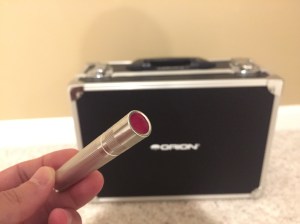
After using the flashlight to set up and organize equipment, I realized the beam was a bit more pink than red, so I added another layer of tape which turned it into more of a solid red beam. While the brightness, at 37 lumens, is slightly more than is recommended, I’m not too concerned about it because I already am contesting with neighborhood light pollution which will hurt my night vision long before this red flashlight will. For only about fifteen dollars, I now have a stylish LED red flashlight that will hopefully keep my night vision a little more intact on those nights of deep sky observing.
Returning to Deep-sky objects
Even though where I live has a decent amount of light pollution, probably a 4 or 5 on the Bortle Scale, there are still a great deal of Galaxies, Star Clusters and Nebula visible in the night sky. These DSOs (Deep-sky objects), provide challenging yet rewarding targets for most amateur astronomers. With the assistance of Skysafari 4’s “Tonight’s Best” guide and the Intelliscope Computer Object Locator of the XT8i, the location of some of these more difficult to find highlights of the early spring sky came into view.
March 29, 2016: Highlights
Beginning in the Western portion of the sky, M38, the Starfish Cluster, was visible around 9:05 PM. While observing M38, a satellite passed through the field of view. These kinds of events are pretty common seeing as how many objects are in orbit. To the upper right of the Starfish Cluster, NGC 1907 barely registered as a slight blur at low magnification using averted vision. Moving over to the South West, the Rosette Nebula continues to refuse to reveal itself, but the open cluster that makes up the heart of it, NGC 2244, was a nice sight. Shifting down towards the neighborhood of Orion’s Nebula brought Sigma Orionis, the highlight of the night, around 9:30 PM. What appeared to be a triple star system revealed a 4th star at 200x magnification. In actuality, it is a quintuple star system, but the 5th star is difficult to pick up with amateur equipment. Attempts at viewing the Crab Nebula came up as disappointing as usual, it was barely visible in the Western sky around 10:25 PM. Finishing out the night was the always impressive pair of galaxies known as Bode’s Nebulae, M81 and M82. At magnitudes +8.39 and +6.90, they never disappoint as distinctive galaxies even if they are around 12 million light years from earth.

ISS Passing Near NGC 2395
March 30, 2016: ISS Fly Over
From 8:53 PM to 9:03 PM the International Space Station sailed over from SW to NE. In an attempt to view it, SkySafari 4 was used to see if the station would appear near any objects during it’s 5 minute pass. This would allow the Computer Object Locator to know where the telescope needed to be pointed before the ISS reached this object, so there could be a quick view of it flying through the eyepiece. Thankfully, at 8:57:51 it would cross near NGC 2395. Right at that time and location, with Lauren looking through the eyepiece and myself looking through the finder scope, we viewed the ISS through the telescope. Traveling at 17,000 miles per hour and being viewed at 48x magnification, the station only appeared in the eyepiece for a second, but the details were impressive. As detailed before from a previous viewing in 2010, the solar panels and cabin compartments of the Space Station were visible. The only difference noticed was that the panels appeared more tilted than on the previous sighting of station back. After the initial contact at NGC 2395, the stations was tracked for another minute or two, on and off, providing additional views as it raced across the sky.
 Late Night Astronomy