If you are looking for a basic starting point in astrophotography, a smartphone eyepiece adapter may be a good option. These adapters along with a dobsonian or other non-tracking telescope can provide nice video and images of the Moon and Planets.
I’ve found that it is best to connect the adapter to the eyepiece near a light source before putting the eyepiece into the telescope. This allowed me to adjust the iPhone directly over the eyepiece at the right distance and angle to capture the light.
Most of these adapters can be found on Amazon for around 20 dollars. If you are interested in making some early steps into astrophotography, I would encourage you to check out this line of products.
This past Sunday, February 26, 2017, a fellow member of my local astronomy club , Bert Herald, invited me over for some observing. Bert has recently purchased an impressive Celestron Cassegrain telescope and tracking mount to do astrophotography.
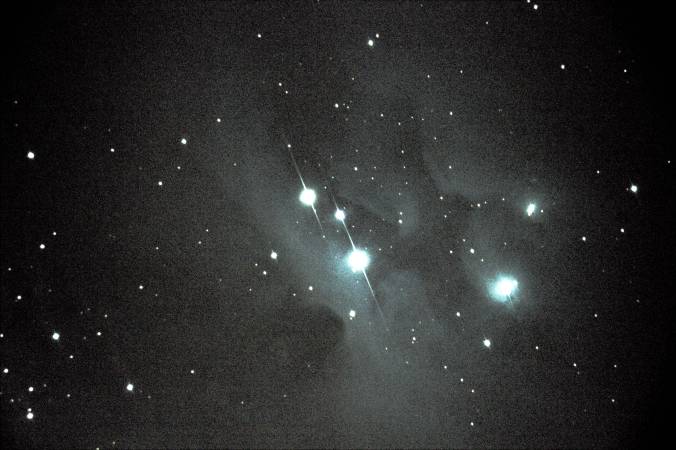
He has just recently moved from afocal imagining, using an iPhone, to the big leagues of DSLR astrophotograpy. The evening started with a complicated and sometimes frustrating polar/5 star alignment which gave me a greater appreciation for the complexity of these advanced telescopes. After some initial difficulties with alignment, later in the evening Bert was able to get some nice exposures of NGC 1983, the Running Man Nebula. He described overcoming some difficulties with the tracking system for this observing session and the process of capturing the nebula:
Tracking continued to suffer even after a second round of alignment! But it was good enough to capture a set of 5 30 sec exposures. I stacked them and briefly edited…
The result of his efforts is an impressive image of NGC 1983, particularly for someone new to advanced astrophotography.
Bert Herald: Running Man Nebula, February 26, 2017
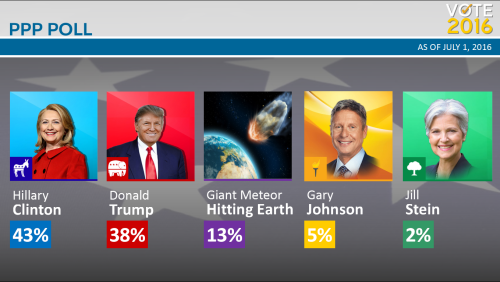
In the 76 year history of Late Night Astronomy, the editorial board has never made an endorsement in a presidential election. That ends tonight. After two debates and over a year of campaigning, it is obvious that only one candidate has the judgment, temperament and stamina to be President of the United States. Through these criteria and after great deliberation, we are throwing our support behind “Giant Meteor 2016”.
Only “Giant Meteor 2016” has the ability to wipe out the national debt and take America back to the glory days of our early republic. While some in the mainstream media will attack “Giant Meteor 2016” for bringing instant death to millions and a slow death to tens of millions more, we simply find these results preferable to a Trump or Clinton presidency.
In fact, a recent poll found that 13 percent of Americans prefer “Giant Meteor 2016” when given the option.
If you’re tired of politics as usual and want something that will truly shake up the system, we urge you to vote for “Giant Meteor 2016” this November. Our children’s future depends on it!
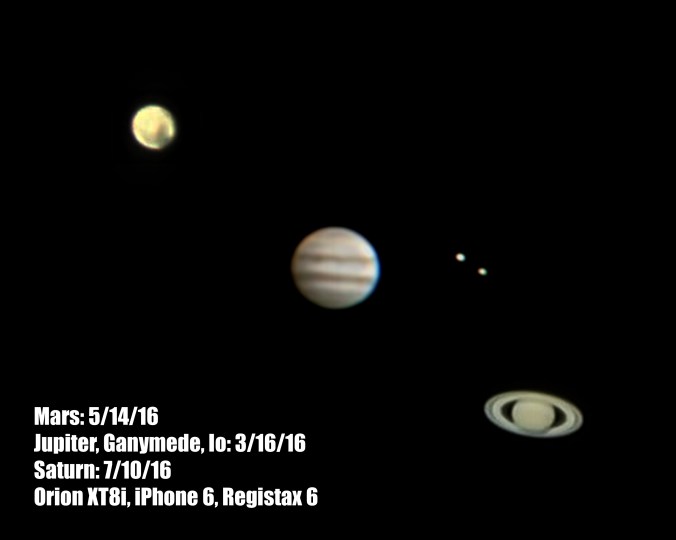
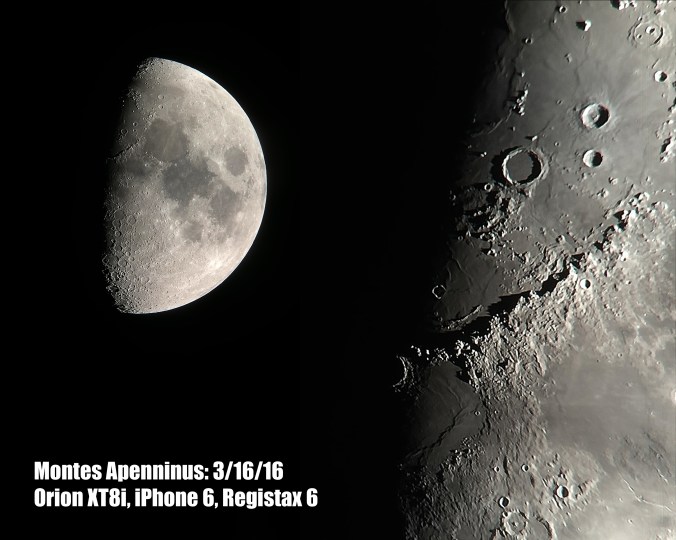
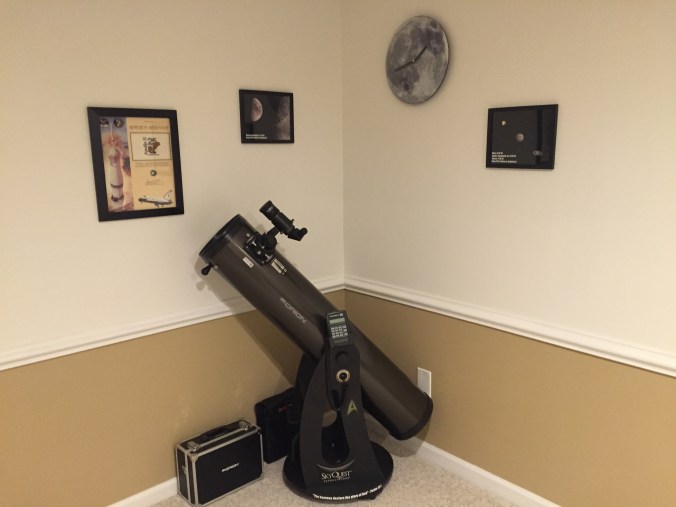
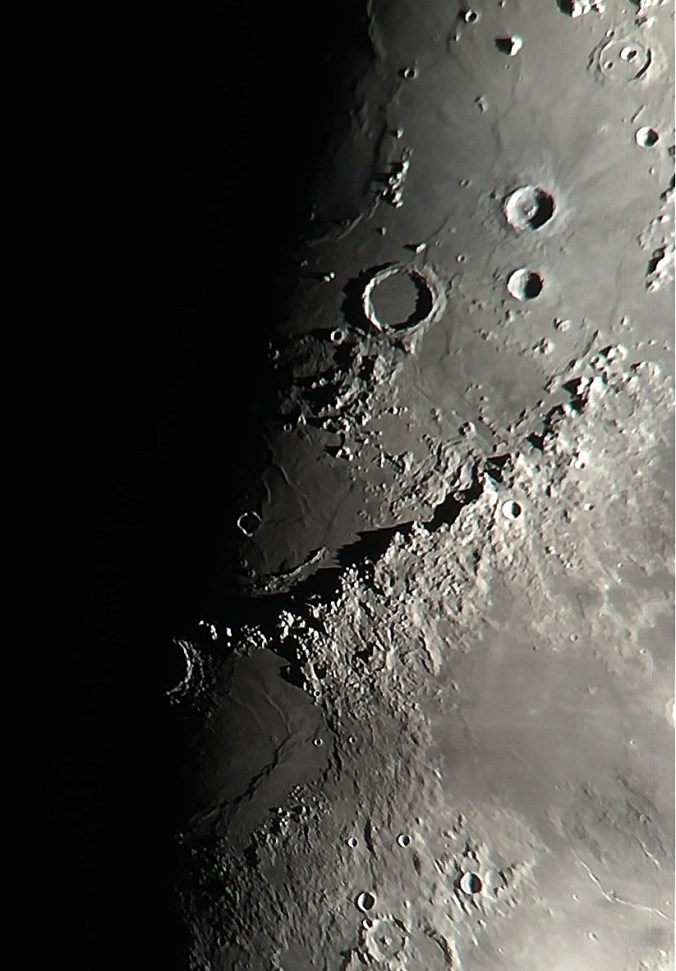
It’s been a while since I’ve updated the photos hanging in the “Astronomy Corner” of the basement. With my recent attempts at planetary and lunar imaging, I felt it was time to change up some of the photos displayed alongside the telescope. Without further ado, here are the prints along with a look at the aforementioned “Astronomy Corner”.
The summer months can be a tricky time for observing. The nights are short, the weather is erratic and dew starts to build up on the telescope as soon as the serious observing begins. Nights that are clear, calm and cool are rare to come by and should be taken advantage of. I did just that on the night of July 10-11 from 10:45 pm to 1:30 am.
Starting with the Solar System Mars:
Viewing conditions were difficult, looking through the turbulent summer atmosphere, views of Mars were less impressive at high magnifications. Also, Mars continues to move farther from us, having made its closest approach to Earth on May 30, 2016 at a distance of 47 million miles, making surface detail harder to make out each night.
Saturn:
One of the highlights of the night, as usual, came from Saturn. With the Cassini Division in full view, this planet always tends to be more forgiving of rough atmospheric conditions, particularly compared to Mars and Jupiter. I was able to try out my new iPhone adapter with the telescope and after some initial alignment difficulties over the eyepiece was able to get a short video.
After being processed through Registax 6 and Adobe Premiere Elements, this image was the final product.
Into Deep Space
The main targets of the evening were Deep Sky Objects. I’ve been chipping away at the Messier List for about six years. These 110 objects are considered some of the best to view and most are attainable with affordable binoculars and telescopes if you are in an area with low light pollution.
Globular Clusters:
Of all the views from this night, the globular clusters were the most difficult to find and disappointing to see. These dense collection of stars were partially drowned out by light pollution and the Moon that had yet to fully set. M80 and M92 were two new ones that I was able to mark off my list. M13 was an impressive show, even with the viewing conditions working against it. The Hercules Cluster is one of the most impressive globular clusters in the sky. I find it hard to focus the object correctly because of how dense the star field is. Various levels of focus almost seem to bring out new layers of detail.
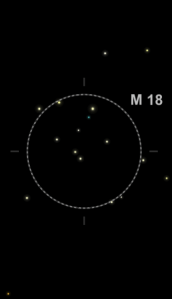
Open Clusters: These collections of stars always impress me with their elegance and simplicity. Not nearly as dense and “fuzzy” as globular clusters, open clusters can be difficult to find but rewarding to discover. Take M18 for example, to verify that I had the correct collection of stars, I had to consult my star chart (Sky Safari 4 Plus on my iPhone) that I was in the correct region of the sky. I did this by counting stars and comparing patterns between what was in my eyepiece and what the chart on my app showed. M23, M26 and NGC 6633 rounded out the list of open clusters viewed.
Supernova Remnants:
One of my favorite sights of the summer sky are the five to eight thousand year old supernova remnants of the Eastern and Western Veil Nebula. I wasn’t sure if NGC 6960 and NGC 6995 would show up from my viewing site, but sure enough with the help of an O-III filter they did. The scale of these two objects is an impressive sight and their ghostly outlines are fitting for the remnants of a dead star.
One last Planet Neptune:
By around 1:30 am, I started to get tired but noticed that there was one planet which had just moved high enough for me to view. Neptune is the farthest planet from the Sun, making it one of the more difficult ones to spot, excluding dwarf planets, sorry Pluto. At 400x magnification, I could make out a faint circular disc with a blueish gray tint. Not bad for something 2.8 Billion Miles away.
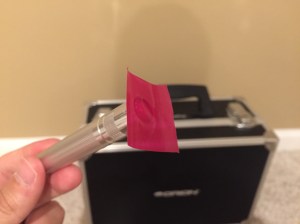
Night vision is key to astronomy. On moonless nights when galaxies, nebulae or globular clusters are at the top of your observing list, properly adapted eyes can be as important as the aperture of the telescope for spotting a “faint fuzzy”. The June and July editions of Sky & Telescope each have articles detailing how to adapt a flashlight for astronomy. Inspired by these articles, I decided it was time to put together my own red flashlight. Since red light is more forgiving to the eye when it is dark-adapted, this is the preferred way to light up an area while still keeping most of your night vision. While red flashlights can be found from companies such as Celestron and Orion for fifteen to thirty dollars, I didn’t care much for their designs and decided to build my own.
Step 1:
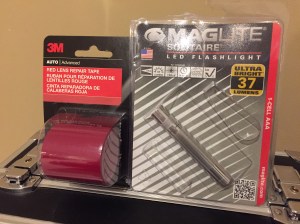
After a trip to Target and Advanced Auto Parts,
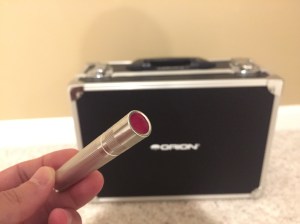
I had an LED Flashlight and Red Tail Light Repair Tape.
Step 2: Cutting out a small piece of the red tape, I placed it over the light.
Step 3: Using a pair of scissors and a sharp knife from “Cutlery Corner”, I trimmed the tape and carefully cut it down to size, only covering the lens.
After using the flashlight to set up and organize equipment, I realized the beam was a bit more pink than red, so I added another layer of tape which turned it into more of a solid red beam. While the brightness, at 37 lumens, is slightly more than is recommended, I’m not too concerned about it because I already am contesting with neighborhood light pollution which will hurt my night vision long before this red flashlight will. For only about fifteen dollars, I now have a stylish LED red flashlight that will hopefully keep my night vision a little more intact on those nights of deep sky observing.
Returning to Deep-sky objects
Even though where I live has a decent amount of light pollution, probably a 4 or 5 on the Bortle Scale, there are still a great deal of Galaxies, Star Clusters and Nebula visible in the night sky. These DSOs (Deep-sky objects), provide challenging yet rewarding targets for most amateur astronomers. With the assistance of Skysafari 4’s “Tonight’s Best” guide and the Intelliscope Computer Object Locator of the XT8i, the location of some of these more difficult to find highlights of the early spring sky came into view.
March 29, 2016: Highlights Beginning in the Western portion of the sky, M38, the Starfish Cluster, was visible around 9:05 PM. While observing M38, a satellite passed through the field of view. These kinds of events are pretty common seeing as how many objects are in orbit. To the upper right of the Starfish Cluster, NGC 1907 barely registered as a slight blur at low magnification using averted vision. Moving over to the South West, the Rosette Nebula continues to refuse to reveal itself, but the open cluster that makes up the heart of it, NGC 2244, was a nice sight. Shifting down towards the neighborhood of Orion’s Nebula brought Sigma Orionis, the highlight of the night, around 9:30 PM. What appeared to be a triple star system revealed a 4th star at 200x magnification. In actuality, it is a quintuple star system, but the 5th star is difficult to pick up with amateur equipment. Attempts at viewing the Crab Nebula came up as disappointing as usual, it was barely visible in the Western sky around 10:25 PM. Finishing out the night was the always impressive pair of galaxies known as Bode’s Nebulae, M81 and M82. At magnitudes +8.39 and +6.90, they never disappoint as distinctive galaxies even if they are around 12 million light years from earth.
ISS Passing Near NGC 2395
March 30, 2016: ISS Fly Over
From 8:53 PM to 9:03 PM the International Space Station sailed over from SW to NE. In an attempt to view it, SkySafari 4 was used to see if the station would appear near any objects during it’s 5 minute pass. This would allow the Computer Object Locator to know where the telescope needed to be pointed before the ISS reached this object, so there could be a quick view of it flying through the eyepiece. Thankfully, at 8:57:51 it would cross near NGC 2395. Right at that time and location, with Lauren looking through the eyepiece and myself looking through the finder scope, we viewed the ISS through the telescope. Traveling at 17,000 miles per hour and being viewed at 48x magnification, the station only appeared in the eyepiece for a second, but the details were impressive. As detailed before from a previous viewing in 2010, the solar panels and cabin compartments of the Space Station were visible. The only difference noticed was that the panels appeared more tilted than on the previous sighting of station back. After the initial contact at NGC 2395, the stations was tracked for another minute or two, on and off, providing additional views as it raced across the sky.
In 2015, I detailed my “Small Steps into Astrophotography”. Since then, I have done little with imaging and processing. That is, until this week. I’ve returned to the complicated, yet rewarding, world of astrophotography. To start, I focused on two great targets for beginners, Jupiter and the Moon. Jupiter, which is near opposition, is as big as it will get in the night sky and the Moon is always a good choice for learning the basics of imaging.
Capturing Video
I began by holding my iPhone 6 over the eyepiece and captured about ten seconds of video for Jupiter and the Moon. The 1080p resolution of the iPhone does a good job at capturing the fine detail on these objects.
PreProcessing Once the videos were captured, I had to find a program that could take my iPhone footage and convert it to a format that my photostacking software could work with. I chose to go with PIPP, Planetary Imaging PreProcessor.
Registax 6 Even though I’ve had some previous experience with Registax 6, I couldn’t remember much about it and had to look up some tutorials that explain the basics of the program. Through this Registax 6 Tutorial, I followed the steps outlined and turned my videos of the Moon and Jupiter into stacked images that brought out fine surface detail.
Jupiter, about halfway through the Registax 6 process.
Premiere Elements To finish up with some additional adjustments to the lighting, sharpness and color hue, I used Adobe Premiere Elements to make some final enhancements.
The Final Results Jupiter and two of it’s moons, Ganymede and Io.
This past summer, while reading Ron Chernow’s “Washington: A Life” a sudden thought came to me:
“I’d really like to read a book on the Apollo program.”
Maybe it was the patriotism, heroism and difficulty Washington experienced throughout his life that spurred these thoughts towards Apollo. Or, maybe I just think a lot about space. Either way, I was sure that when I finished the Washington biography, it would be on to the moon for my next read. A quick search of amazon.com revealed that there is no shortage of biographies and autobiographies detailing specific missions from the Apollo Era. Having read Jim Lovell and Jeffrey Kruger’s “Lost Moon,” I was more interested in a single volume telling of the lunar landing saga from the tragedy of Apollo 1 to the triumphant conclusion of Apollo 17. It soon became clear that to satisfy this goal, Andrew Chaikin’s “A Man on the Moon: The Voyages of the Apollo Astronauts” was going to be my best bet.
“Earth Rise”, Apollo 8
Chaikin begins with the launchpad fire of Apollo 1, giving detailed and graphic descriptions of this horrific accident that took the lives of three astronauts and nearly ended the Apollo program. The inner workings of NASA quickly become apparent early on in the book, from the selection process for the Astronauts to how Deke Slayton chose who would fly each mission. As Apollo 7, 8, 9 and 10 took significant steps towards the first moon landing, Chaikin displays the emotional impact that these missions and others took on the families of the astronauts. With, Apollo 11, 12, 13 and 14 the challenge from John F. Kennedy was met, exploration began to expand, NASA showed its true excellence through a “successful failure,” and the first American in space returned to flight. The most knowledge I gained came from the descriptions of the geologic training and exploration that occurred during the missions of Apollo 15, 16 and 17. The astronauts of these missions, became lunar geologist almost as much as they were pilots. While the scientific terms were sometimes beyond my understanding, the detail that Chaikin provides in this section shows the immense scientific discovery that occurred on the moon.
Buzz Aldrin, Apollo 11
Alan Shepard, after being grounded for so many years due to an ear disorder, finally made it to the moon, looked up at the Earth and began to cry. Edgar Mitchell secretly attempted an ESP experiment with psychics on Earth as he headed towards the moon at over 25,000 mph. Buzz Aldrin, took communion on the moon after he and Neil Armstrong landed the Eagle at The Sea of Tranquility. These stories are the greatest strengths of the book and often come from the access Chaikin was granted for interviews with 23 of the 24 astronauts who traveled to the moon. Their insightful recollections and sometimes emotional reveals provide the heart to what could otherwise be a rote retelling of process and checklists akin to an Apollo flight plan.
The book ends with a look at the various impact this journey had on the astronauts who undertook it. Neil Armstrong largely receded from public life following his “small steps,” becoming a college professor. Buzz Aldrin, under the pressure and stress of the public eye, fell into manic depression and suffered from alcoholism. Gene Cernan, through his exuberant personality, did public speaking tours around the world telling of his experiences on the lunar surface. The impact of the Apollo program on these men is best displayed by an insightful quote from Al Bean. Bean, who became an artist after leaving NASA, said “I think that everyone who went to the moon came back more like they already were.”
“I’ve been there. Chaikin took me back.”
Gene Cernan, the last man to walk on the moon, wrote these words in praise of Andrew Chaikin. While reading through the challenges and triumphs of Apollo, I felt like I was right there with him.
Since the invention of the telescope in the 17th Century, an astronomer’s limit of what can be viewed through the eyepiece has always come down to the sensitivity of the eye peering through the lens. With the invention of photography in the early 19th century and the digital revolution of the late 20th century, the limits of what can now be viewed depend much more on the image sensors, exposure times and tracking systems being used by the observer. As far as we have come in amateur astronomy and digital photography, astrophotography continues to be a complex and expensive extension of this hobby.
Thankfully, the technology to begin experimenting with this process has become embedded in devices used on a regular basis. Late in 2014, I bought the iPhone 6, which among many of its improvements, boasted of an enhanced camera. To test this and try out my hand at astrophotography, I took a couple shots of some of the night sky’s most well known targets.
Orion Nebula Starting with Orion Nebula, I had little expectation for success. As I slowly adjusted the iPhone 6 over the eyepiece, the image came into auto focus, and I was surprised to see the brightest parts of the nebula appearing on the screen. I snapped a handful of images and video, with the one shown above being the most impressive in terms of the gray cloud-like detail of the nebula and sharpness of the Trapezium Star Cluster, located at its center. To my eye, the Orion Nebula appears as a soft bluish-green cloud, but to achieve that through a camera, a longer exposure would be needed.
Pleiades Star Cluster Moving the scope over to one of my favorite star clusters, the Pleiades Star Cluster revealed the most prominent of the Seven Sisters in sharp detail.
Jupiter and the Galilean Moons Jupiter along with its moons Io, Europa, Ganymede and Callisto proved to be a difficult set of objects to accurately capture together. The aperture was a difficult thing to adjust while holding the camera lens over the eyepiece. While it is nice to be able to see the four major moons of Jupiter in this image, collecting enough light to capture them, leads to an over exposure of Jupiter itself. While the major cloud belts are perfectly viewable through the eyepiece, they are washed out in the image.
Astrophotography has been one of those things that I have dabbled in from time to time, but never taken seriously due to a lack of proper equipment. These examples, however, show that with a bit of patience and a smart phone, you can begin to explore the world of astrophotography.