Comet Lovejoy: On a Cold Winter’s Night

Nights like these were made for amateur astronomers. A cool 27 degree night with little wind and no moon awaited. Preparing for the session has always been half the fun. Creating a mental list of what is going to be out and putting on some coffee as various layers of clothing are added to try and eke out as much precious time as possible before the cold finally wins out and ends the night. Tonight, there were few things on the list after a sunset viewing of Venus and Mercury less than 1 degree apart. The main event was a comet recently discovered in August of 2014 dropping by the neighborhood, which goes by the name Lovejoy C/2014 Q2.

The hunt for Lovejoy began with Skysafari+ on the iPhone 6. Located on this night, near the constellation Taurus and in between stars Nu Tauri and Xi Tauri; Lovejoy shined at a magnitude +4.9 and was visible to the naked eye even from the orange/yellow light polluted sky of Southwest Virginia. Starting out with the 2 in. Q70 38mm, Lovejoy popped into life at 32x magnification revealing a diffused cloud with a slightly greenish/gray color along with a surprisingly noticeable nucleus. While others have been able to make out its tail, I was not able to do so, most likely due to light pollution. From 32x to 200x magnification, Lovejoy continued to impress with the best views being in the 48x to 96x range.

This comet was much more impressive than previous ones viewed, including Lulin in February of 2009 and Panstarrs in June 2014. If you have a telescope or set of binoculars, January will continue to be a good time for observing. But don’t worry if you miss out, most estimates have Lovejoy returning in about 8,000 years.

Mars is Back!

File:Mars Earth Comparison.png

Mars is back, and I have a hard time believing how much time has passed. It was in February of 2012 that I last wrote about “The Return of Big Red”. Since that time, much has changed on Earth and a hovering sky crane lowered “Curiosity” onto Mars’ surface, continuing NASA’s legacy of remarkable planetary research and exploration. I was almost caught off guard by this years Mars opposition with Earth. If not for a student telling me about his recent observations during our monthly “Air and Space Club” meeting at school, I would have probably missed the best views Mars over the next two years.

Thankfully, this was not the case and last night I went out, with my wife in tow, to view “Big Red” for the first time since June 19th, 2012. After adjusting the telescope to avoid trees obstructing our view, the 6mm Zhumell Planetary Eyepiece was put in and at 200x magnification Mars did not disappoint. Even though it is still about three weeks away from it’s closest pass to Earth, land features such as Syrtis Major and the Polar Ice Cap were visible. Attempting to use the Orange #21 color filter did not yield any further detail. As is normally the case, simply waiting for those moments of sharp views when the atmosphere settles down, brought the best moments of the night.

File:Marsorbitsolarsystem.gifAs Mars and Earth continue their Solar System Dance, catching up with each other every two years, be sure to head out and take a look by the middle of April before we again start to slowly move away from each other. If you happen to miss this one, fear not, because come 2016 and 2018, Mars will be even more impressive in size and detail through a telescope because of how odd it’s orbit coincides with our own.
A Presentation By Apollo 14 Astronaut, Dr. Edgar Mitchell

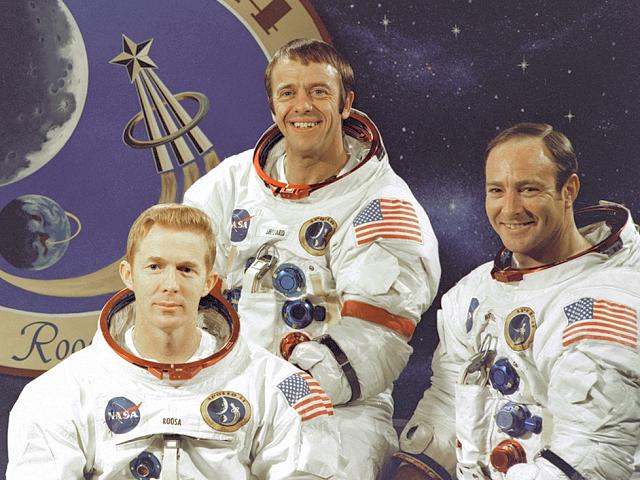
Apollo 14 CrewAfter leaving work a couple minutes early to beat traffic, my good friend and coworker Eric and I, arrived at the Science Museum for a presentation we had been looking forward to for weeks. Dr. Edgar Mitchell was the sixth person to walk on the Moon and with that feat he joined an elite group of astronauts, of which only eight are still living. Dr. Mitchell’s presentation centered around his Apollo 14 Mission with fellow astronauts Allen Shepard and Stuart Roosa to the Fra Mauro region of the Moon, which was originally intended for the ill fated Apollo 13 mission. Going through the details of their mission reminded me of the complexity and ingenuity that was required to successfully take these men to the Moon and return them safely to the Earth.  Even though there wasn’t time for pictures or a handshake at the end, I still consider it an honor to say that I was in a room and got to hear the story of how we went to the Moon from someone who has actually walked on it.

It is incredible to me that there are only eight people alive who have walked on the Moon. After all of the promises of lunar bases and tickets sold for the Moon in the late 60’s and early 70’s, I’m sure few during those exciting decades of space travel would have guessed that we would just simply stop going. While I’m sure there will be a time in my life when we will return to the Moon, perhaps in decent numbers, until that time comes, the era of the Apollo program will continue to be our nostalgic view back at a future we had hoped would be more promising for lunar exploration.Edgar Mitchell

NASA Is Just Awesome

Of all the images to come out of the landing of Curiosity on Mars, nothing compares to this.

NASA spent months figuring out calculations to get the Mars Reconnaissance Orbiter into perfect position and orientation at the right time to capture this image of Curiosity in its final descent stage to Mars.

Live Updates: Curiosity Lands on Mars

We will be bringing live updates throughout the night, during this exciting event!

Here is a great overview of what will happen.

12:12am-NASA has just cut communications with Curiosity, making it entirely on its own for the duration of the landing.

12:30am-Navigation report from Curiosity shows that all is well.

12:35am-Here is a really cool website that gives a CGI view of what is going on with Curiosity.
www.eyes.nasa.gov

1:14am-Cruise stage seperation has just occured.

1:16am-The vehicle is traveling at nearly 12,000 miles per hour and is 2,000 miles from Mars.

1:24am-Curiosity has entered the Martian atmosphere.

1:28am-Parachute has deployed and heatshield has seperated!

1:31am-Curiosity has landed!

1:35am-First image received!

It’s really moving to see all of the people who have dedicated so many years of their life to this moment celebrating! It’s just incredible to me that it all worked!

Some Lunar Views and Spotting Saturn’s Cassini Divide

I love setting up a telescope with the Sun setting and the sky slowly transitioning from day to night. There is something exciting about planning what will be viewed and the anticipation of what is to come.

The night started out with some brief views of the crescent Moon. This is my favorite time to view the lunar surface. The shadows that are cast from the mountains and craters display incredible depth and make the Moon almost appear 3d though the eyepiece. Sadly, anything over half full and its surface becomes boringly flat, turning the Moon into a nuisance that does nothing more than spoil the view of deep sky objects with its light pollution.

Continuing into the evening, I was pleasantly surprised to find that Saturn was visible in the early nighttime sky. Easily, a favorite of mine and Lauren’s, its rings are now tilted to a point that will offer incredible views of the planet for years to come. Pushing the telescope up to 200 times magnification revealed the beautiful angle of its rings as well as the cassini divide that splits the rings themselves.

Holding up my iPhone to the eyepiece, I was able to take some pretty good video of the planet. The cassini divide is too thin to view in the video, but you can easily make out the divide between the rings and planet disc itself.

Starlog: May 25th & 26th, 2012

The End of the Transit and Meeting a Fellow Amateur Astronomer

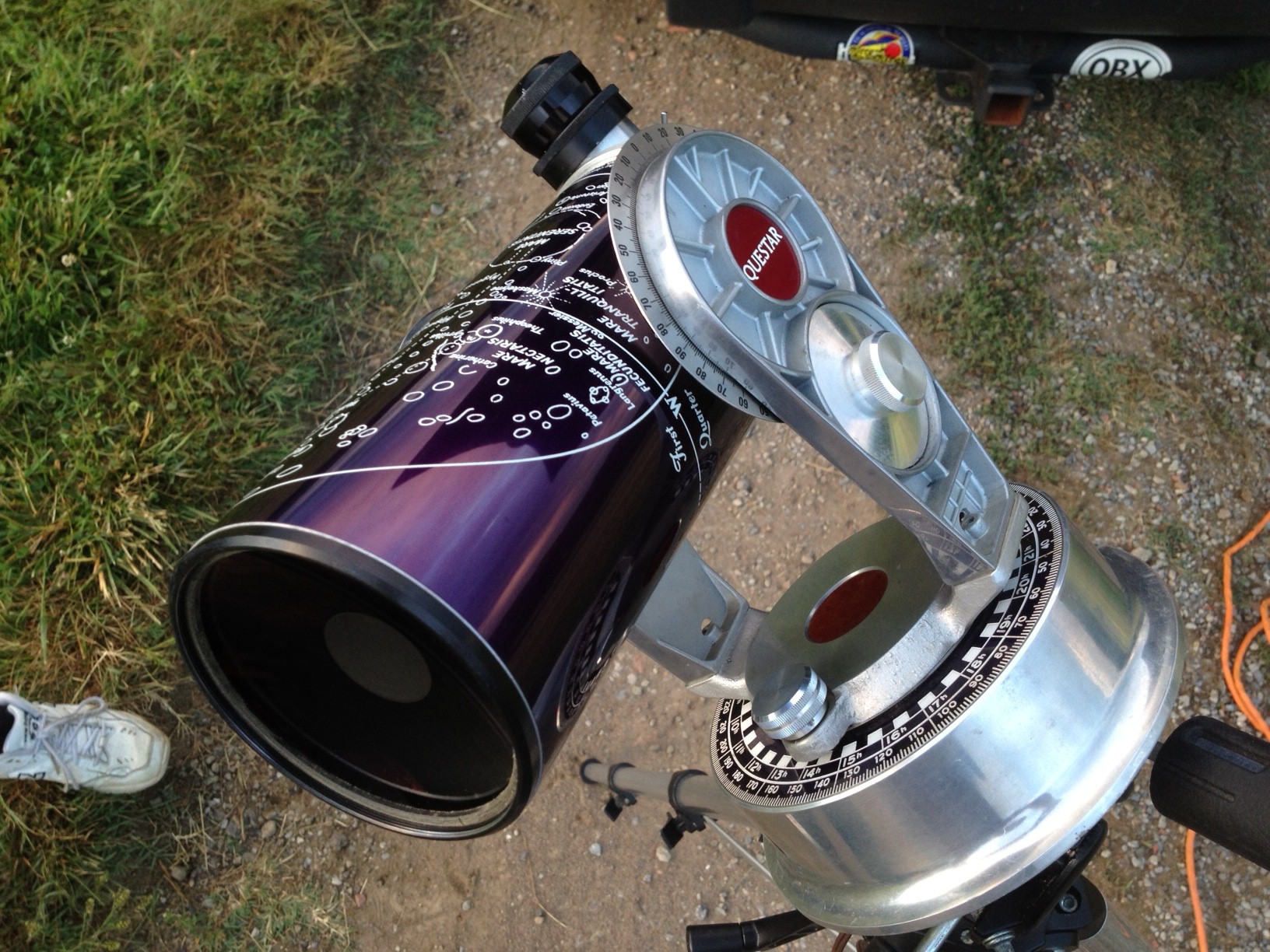
On the way back from a short trip to Bedford, Lauren and I noticed someone with a tripod on the top of a hill at Hollins University. We pulled over and walked up to the man, who, I had assumed correctly, was viewing the transit of Venus through a telescope with a solar filter. Unfortunately, the clouds did not part enough for Lauren and I to get a view through his telescope, but we did talk to the nice man, for several minutes, sharing some amateur astronomy stories and shooting the breeze about a variety of topics. I was very envious of his telescope, a classic 90mm “Questar” that, as he explained, has exceptional optics for planetary, lunar and solar viewing. It is rare that I get to meet someone else with a passion for this hobby, and it was the perfect end to an exciting day of views that were literally once in a lifetime!