Star Log: March 6, 2010

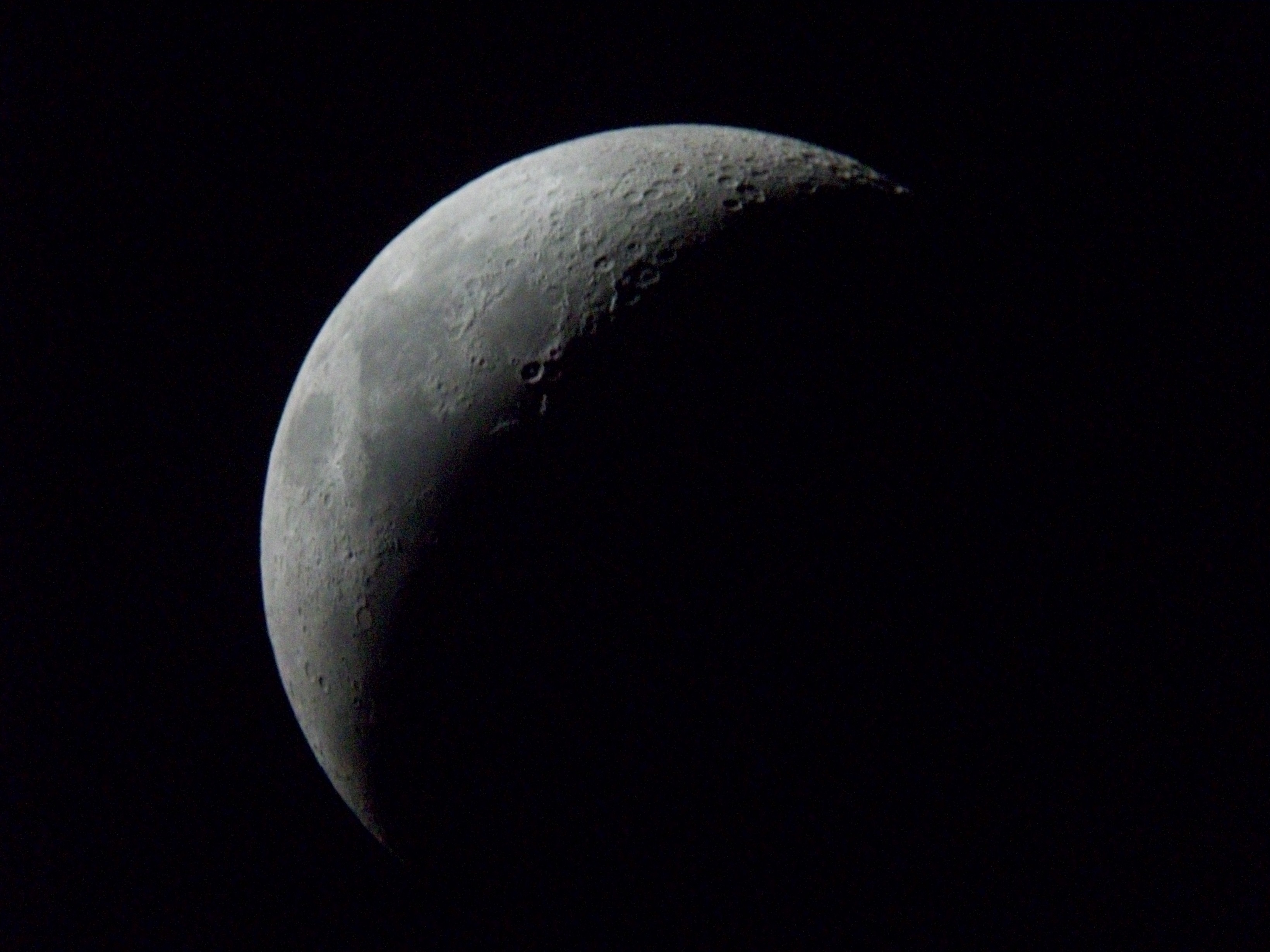
A beautiful Saturday with temperatures in the mid 50’s led way to an exceptionally clear night here in Clifton Forge.  Going from the light polluted skies of Roanoke to the dark skies of the county never ceases to amaze.  After washing my car (long over due) and working on some lesson plans, I decided to take my scope out with about an hour of sunlight left.  The hope was to get a glimpse of Venus at sun set while allowing the telescope to have a steady cool down.  Unfortunately, Venus was still too low on the horizon to observe (this will change come late spring and summer).

Mars
While still close enough to Earth to make out a spherical disc, Mars is moving away from Earth at a fairly substantial rate and will be too far for detail come April.  With that being the case, any chance to view “Big Red” should not be missed.  Tonight’s view was a fairly typical if not unspectacular view.  The atmosphere was very calm, making high magnification planetary viewing sharp; but Mars had little land features to show due to its “boring” side facing Earth on this particular night.  All that could be made out was the northern polar ice cap.  With that said, being able to make out any detail on Mars is still exciting.  Just ask Lauren about the night I had us stay up until 4 in the morning to view Mars through the old DS-114 only to reveal a somewhat bright red star (I’m lucky she hasn’t left me).

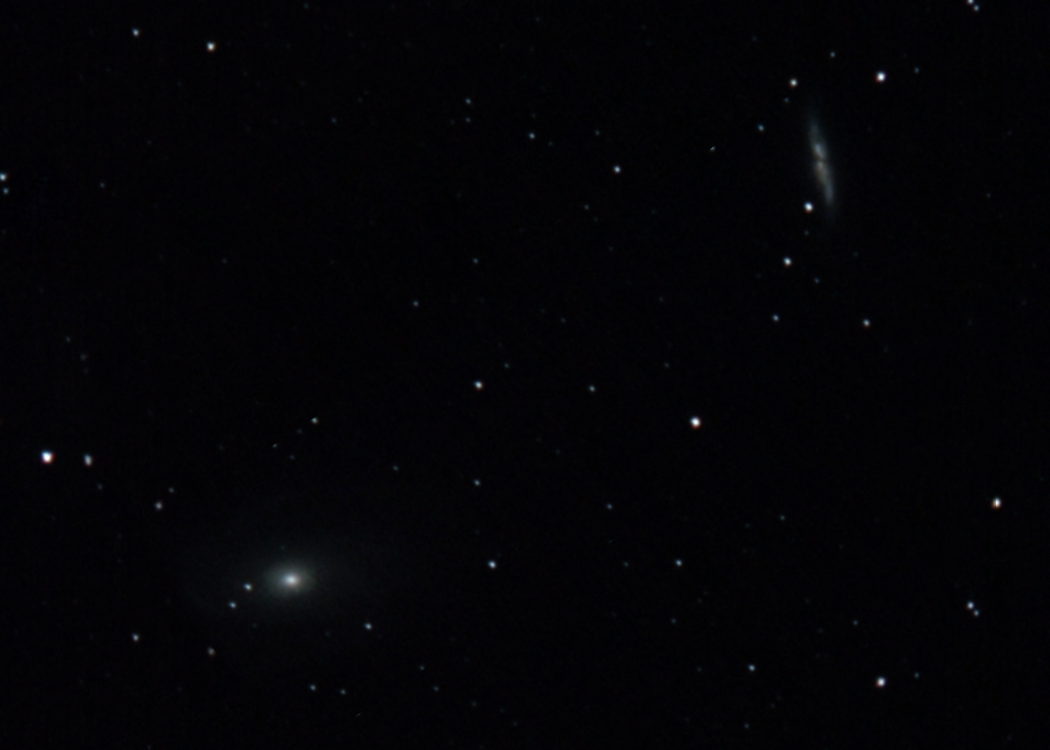
M81 & M82
Faint fuzzies are how most people describe deep-sky objects and while I have to agree with this assessment, don’t let the name fool you, these objects are an amazing sight.  Two of the best ones to view in the winter sky are M81 and M82.  My 8-year-old sister Abby described the irregular galaxy M82 as looking like the number 1 in space.  What makes these two objects even better is that with wide enough field of view you will be able to view and compare these spiral and irregular galaxies at the same time due to their apparent location in our sky.   While no structural detail could be discerned from these two objects, knowing that you are looking at an object 12 million light years away and effectively looking 12 million years into the past is an incredible feeling.  Although I have to agree with Abby, seeing the number 1 in space was pretty cool too!

Visual representation of M81 & M82

Getting Back in the Game

About a year ago, I got back into astronomy.  What had been a hobby of mine since childhood had turned into a frustration over the years because of faulty equipment and a lack of knowledge to effectively view the night sky.  My first telescope was a present from my Paw Paw for Christmas in the mid 1990’s (Oh, Those Wonder Years).  It was a 60 mm refractor and the only memories I have of it come from viewing Jupiter, Saturn, and the Comet Hale bop.  My second telescope came in Christmas 2000.  It was a 4.5 in. reflector telescope that would serve as my main scope for ten years.

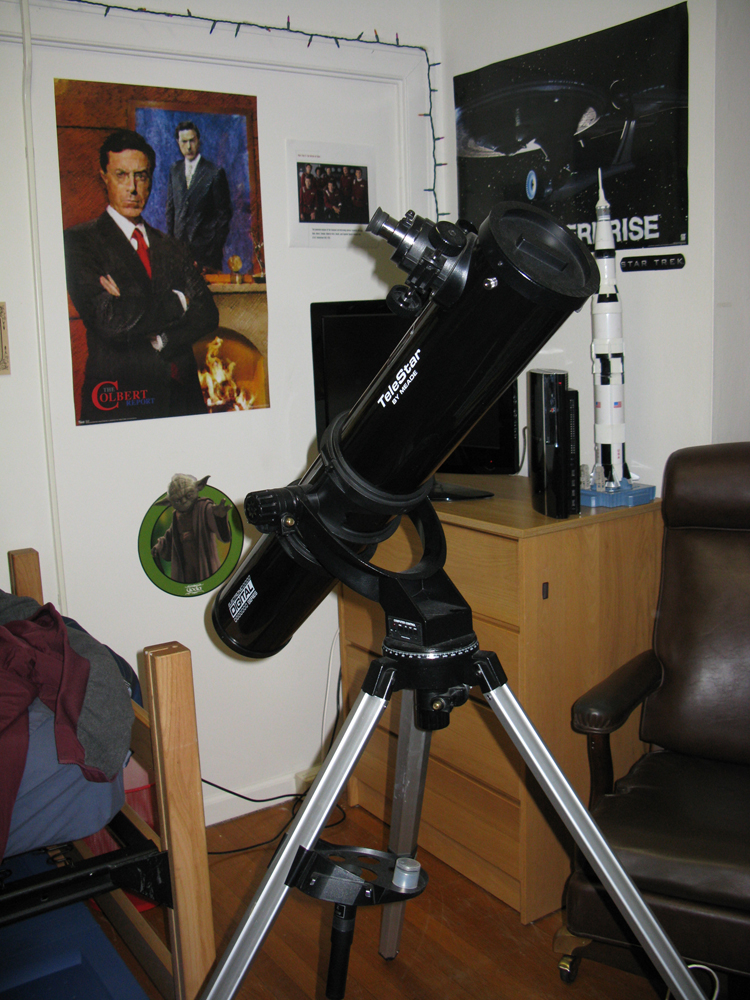
Meade DS-114 AT
Diameter-114 mm
Focal Length-910mm
(How many “nerd markings” can you find in this picture?)

As time went on, I would observe less and less with the DS-114 because of frustrations from its “goto” feature.  Considering my age at the time (13) a telescope with motorized features was probably not the best idea, but boy did it look awesome set up in my room.  As the years went on, I would occasionally take the telescope out on a summer night to view the moon or randomly scan the sky.  Once, I remember coming across a group of spectacular spiral galaxies, but those “accidents” were few and far between.  Fast-forwarding to the winter of 2009, I had pretty much abandoned astronomy, while the interest was still there, I began to see it as a thing of my past.  That is, until one cold winter night on the tennis courts of Roanoke College.

I had recently decided to fetch my telescope from the basement of my parents house during Christmas Vacation from college.  I dusted the old lady off and to my surprise, all of the eye pieces were there and the telescope was in good condition.  Bringing it back to the college, Lauren and I decided to take it out onto the back tennis courts on a clear and cold December night.  After removing the “goto” motors (apparently it wasn’t my age, they are just crap), I moved the telescope by hand as best I could, the motions weren’t exactly smooth but never the less it was a great improvement from the battery draining, slow-moving motor system of the past.  About an hour had passed, the cold weather was starting to get to us and then a star caught my eye.  It had a dull orange/yellow glow to it.  While it was not the brightest star in the sky by a long shot, something just look different about it.

I pointed the telescope, looked through the eyepiece and was shocked to see a small ball with rings.  Lauren and I had discovered Saturn (Yeah I know that boat sailed a long time ago) but it felt like we had discovered Saturn for the first time.  This was the first time I had viewed the ringed wonder in a couple of years and I felt the joy and excitement that I remembered as a child trying to find objects in the back yard with nothing more than a “goto” telescope that didn’t really work to well and some star charts I had no idea how to read.  It was this moment that sparked my re-interest in astronomy and led to my search for a new telescope that would allow me to easily find and study lunar and planetary details as well as deep space objects.  The journey had begun and the hunt was on for what would be a nearly year-long quest to find the perfect telescope.

Michael

Clear Skies Are Back

Warm weather and clear skies have finally moved into the Roanoke area.  (Warm weather of course meaning temperatures in the high 30’s)  After weeks of nasty snow storms and consistently cold weather “Clear Skies Are Back”.  With this warmer weather comes the opportunity to finally extensively use my Orion XT8i Telescope.  I’ve only been able to use my telescope a handful of times since Christmas.  This Saturday proved to be a good test of its abilities.

After seeing some very interesting plays done on campus (Yeah, I’m talking to you crazy, murdering, lesbian lovers) Saturday Night’s line up for Lauren and I included Mars and Saturn.  I have viewed all of these objects before with this telescope but not with a 2x barlow lens to really push the magnification.  Thanks to a gracious professor at Roanoke College who allowed me to borrow the lens, I was able to view Mars and Saturn for the first time at 240x magnification.

Mars:
Lauren and I were able to make out some very distinct land features on Mars that we had never seen before.  At the previous 120x magnification, I could make out the polar ice caps and some subtle hints of land features.  With the 2x barlow lens added Lauren and I were both able to clearly make the Northern ice cap but more amazingly dark land features, specifically Syrtis Major, which is a low-level shield Volcano remnant.  Lauren described it as looking like a dark spot and I thought it looked like Africa.  Here is a good representation of what we viewed.


Saturn:
Following Mars we viewed the always  beautiful Saturn a little after midnight.  Saturn’s Rings are at a fairly flat viewing angle (equinox) to Earth for the next couple years but Lauren could make out a little bit of the divide between the rings and the planet.  We could also make out 4 of Saturn’s moons including the impressively bright, Titan.
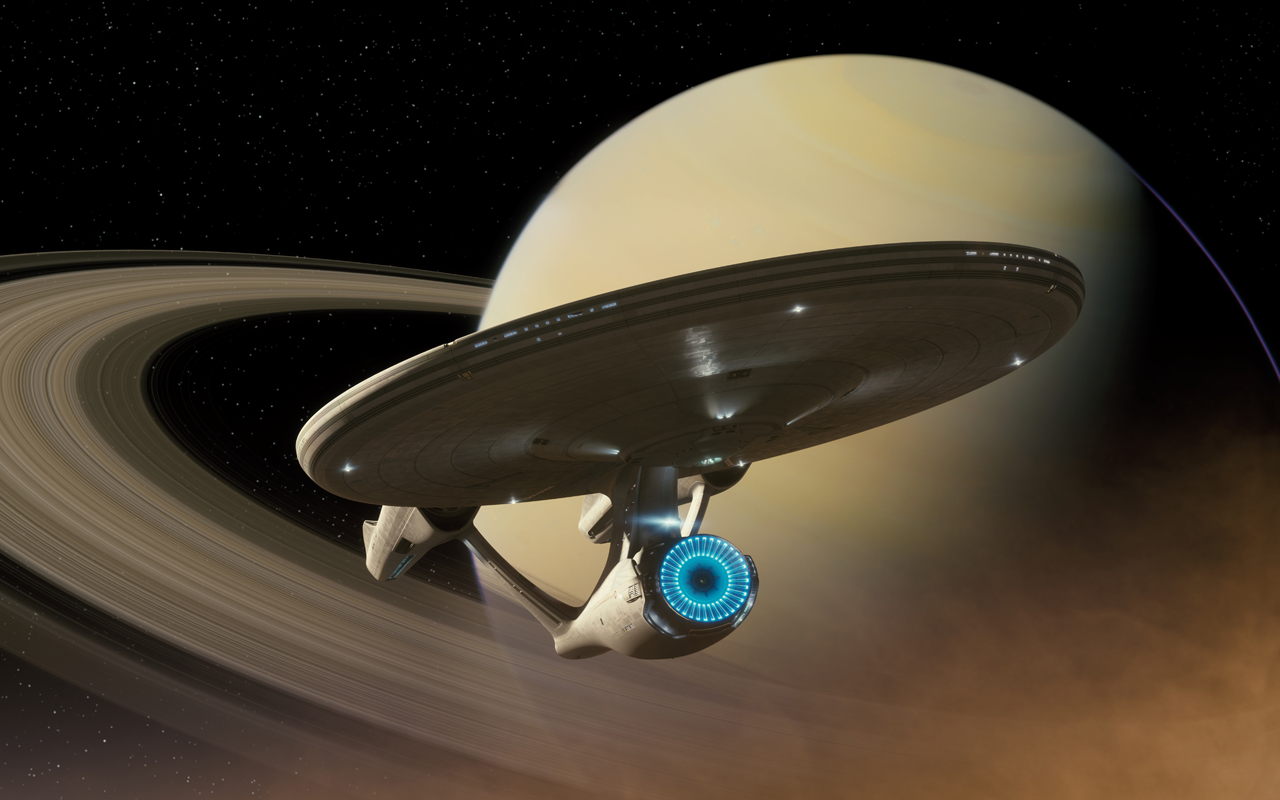
Here is how Saturn looked, needles to say it made my night!  And yes the Enterprise was there, I swear
(Don’t ask Lauren)

All in all it was a very enjoyable night out on the Front Quad of Roanoke College.

PS-Thanks to all of you who took great concern in seeing my telescope out by itself with a sticky note on it reading “Be Right Back” (The first time I took it out on campus it had three sticky notes on it “Do Not Touch” “College Property” and “Under Servelance”)
Yeah, I know it was spelled wrong!

Clear Skies All,
Michael