Deep-Sky List: Stars & Star Clusters

Every amateur astronomer needs a list.  Going out and blindly observing, without any idea of what you’re looking at, is enjoyable for a while, but wears thin overtime.  Compiling a variety of objects to view will help to hone your skills while making the most effective use of those few nights with exceptional seeing conditions.  Here is my starting list of  Double, Carbon and Red Giant Stars as well as Open and Globular Star Clusters I hope to view over the next few months and years.

  • Double Stars:(Two or more stars orbiting each other)

Mizar-Middle Star in the handle of the Big Dipper
Gamma Arietis-Headlight Double
Gamma Virginis-Headlight Double
Albireo/Beta Cygina-Color
Delta Cephei-Color
Gamma Andromedae-Color
Antares-Color
Sirius-White Drawf Star Difficult to See

  • Carbon Stars:(Glow Strong Red. Slightly defocus occasionally to bring out color)

Mu Cephei
R Leporis
Ruby Crucis

  • Red Giants:(Glow Yellow Orange)

Betelgeuse
Aldebaran

  • Open Clusters:(All stars can be individually resolved)

Pleiades-Low Power/Binocular Viewing
Beehive-Low Power/Binocular Viewing
NGC7789-Rich Cluster/100 or more stars
M11-Rich Cluster
Jewel Box Cluster, NGC4755-Rich Cluster, Ruby-red star in a field of blue stars
Gem Cluster, NGC3293-Rich Cluster
NGC457-Poor Cluster/Less than 50 stars, Apparently looks like E.T.
NGC 2169-Poor Cluster, Resembles the number 37 or an XY
NGC2477-Very rich open cluster, nearly a globular

  • Globular Clusters:(Appear as a haze, harder to resolve individual stars)

M13
M3
M5
NGC288-Loosely concentrated
NGC5466-Loosely concentrated
NGC 5897-Loosely concentrated
M71
NGC2419-Very small, faint and distant, 300,000 light years
NGC7006-Very small, faint and distant, 185,000 light years
M55-Belongs to Sagittarius Dwarf.  A companion Elliptical Galaxy of the Milky Way

Source:The Backyard Astronomers Guide

Star Log: March 20, 2010

After a late Friday night, I awoke at noon on Saturday and walked over for brunch to find around a hundred people standing outside of the Colket Center with two fire trucks near by.  Thankfully all was well, save for a minor fire in the kitchen area.  Lauren returned from her trip to Boston later in the day and we went on a nice walk to an antique store in downtown Salem.  Upon returning to the dorms, I came across an internet article about the International Space Station and thought it might be a good idea to see if  it would be flying over anytime soon.  Surprisingly, later that night at 8:12pm it would be making a 5 minute fly over from North West to East South East, making  tonight a perfect opportunity for my first attempt at viewing the ISS through a telescope!

International Space Station Fly Over:
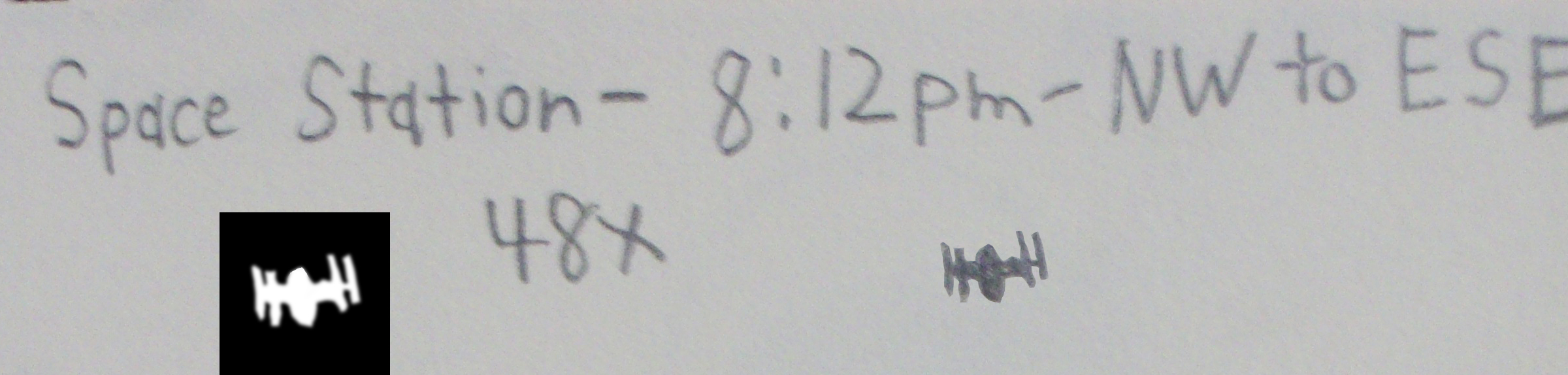
Around 8:00pm, my friend Andy and I set up the telescope on the back quad of the college.  The sun was setting and we had spent about a half hour observing the Moon.  A few minutes before the fly over, two men from  a music group called Barefoot Truth, who were performing on campus that night, came over and asked what we were looking at.  They took some quick views of the Moon and were very interested in seeing the ISS.  Around 8:11 the most beautiful thing I have ever seen in my life appeared from the distance, it was Lauren, who was fashionably late, showing up just seconds before the Space Station.  8:12 swings around and right on schedule a dim star appeared right above the Colket Center sailing across the sky.  It began faint but became as bright as Venus it passed over head.  Now came the hard part, attempting to view in through the telescope.  It can be difficult enough to find and track a slow-moving planet, never mind a football field sized Space Station moving at 17,000 mph and orbiting 200 miles above the Earth.  After about 20 seconds of attempts,  it finally became visible and flew through the field of view in less than a second, looking like a very bright blur.  At this point there were now 5 people hanging around the telescope and all got at least a split second view of the space station through the eye piece while I tracked it through the finder scope.  As it continued to move across the sky one more attempt was given to actually try to keep it in the eye piece’s field of view for an extended period of time.  This was accomplished just as the Station was near its highest point in the sky and through tracking it for around 5 to 10 seconds the bright blur that had been viewed earlier turned into a detailed object.  At 48X magnification,  the pods in the middle where the astronauts are located were somewhat visible, but more amazingly and sharp were the two sets of solar panels on both sides of the Space Station.  The way is which the Station glowed with brightness, particularly the inner pods, along with the detail that was discerned from its solar panels truly made this one of the most memorable experiences I have ever had in astronomy.

Sketch of the ISS as viewed at 48X magnification:

Later in the night, Mars, Saturn and the Moon would be observed, but none of those objects could hold a candle to the couple of seconds spent viewing the Space Station with its inner pods and detailed solar panels.  Never before have I observed an object in space that has people working and living on it through a telescope.  As we looked up and saw the Space Station sailing across the night sky, I couldn’t help but wonder if one of the astronauts was looking down at us here on Earth.  Hundreds of thousands of people have seen the Space Station at night, whether they realized it or not.  My guess is that only a few thousand have observed it through a telescope.  After tonight you can add Lauren, Andy, two guys from Barefoot Truth (thanks for the free CD’s, by the way), a random college employee whose name I didn’t get and myself to that list.

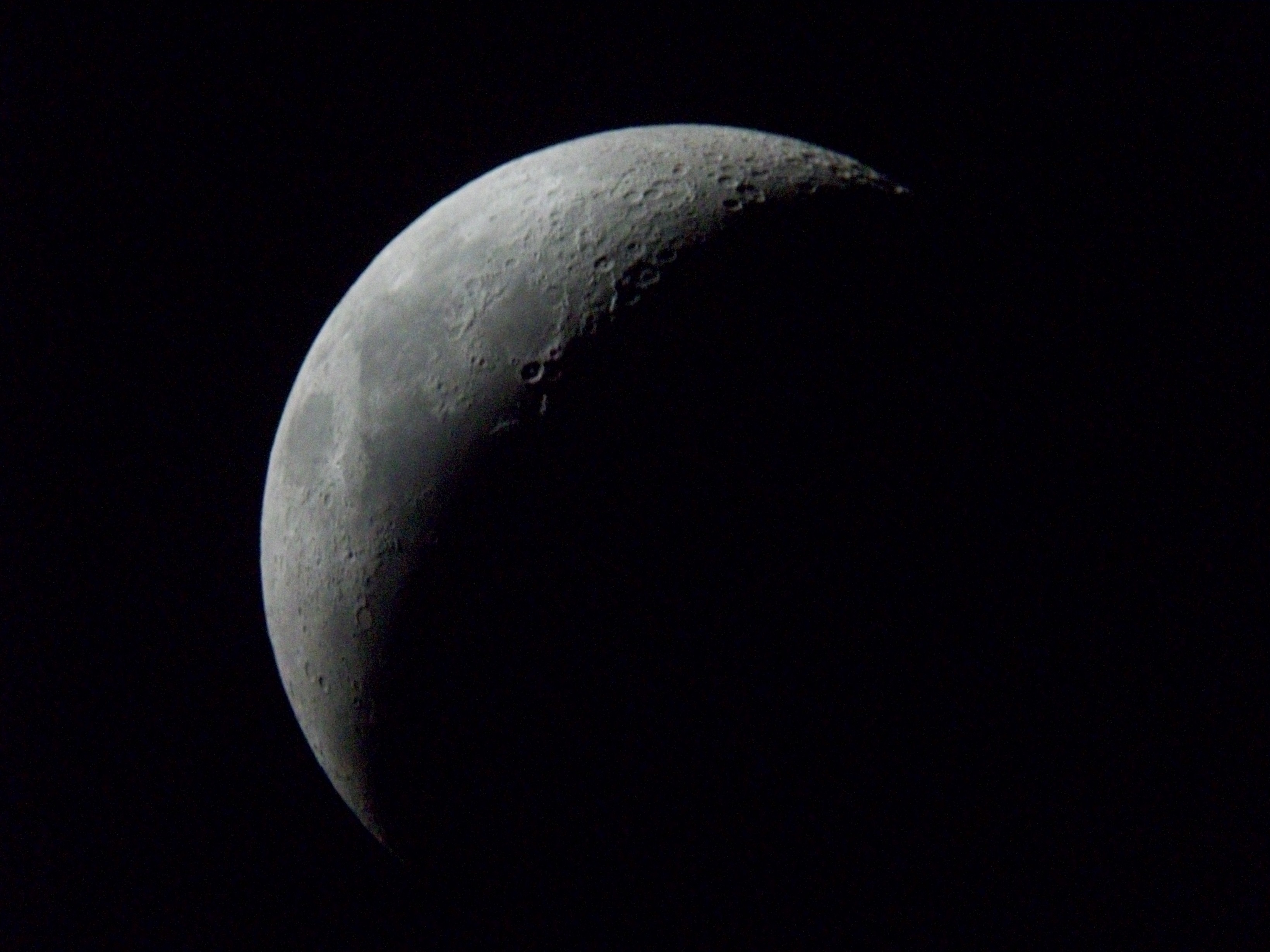
Pictures of the Crescent Moon, taken on this night, complements of Lauren:

Star Log: March 19, 2010

A busy yet enjoyable week of student teaching made the warm weather and clear skies of Friday all the more welcoming.  With Lauren off on a trip to Boston presenting a scholarly journal essay on the Chicano movement and perfectly clear skies out, not observing would be near criminal negligence  (See: Section 4 paragraph 8 of the Law Code of the Commonwealth of Virginia).  Tonight would also be my first attempt  at sketching what was observed.  The goals being to attempt a sketch of the Moon and Mars as well as tracking the orbits of the Moons of Saturn throughout the night.

Lunar Observing:

Prior to this evening, little time had been spent viewing the moon through the XT8i.  With the Moon’s current phase being waxing crescent, tonight would be a perfect opportunity to explore the lunar surface.  It is best to observe the Moon when it is half full or less because details aren’t washed out by the brightness and long shadows cast on the surface help distinguish mountain ranges and craters.  Tonight proved this advice to be correct with the most fascinating parts of viewing being a specific region of craters right along the terminator, observed at 120 and 240X magnification, that had shadows moving down their sides giving a great field of depth to their make up.  With my 25mm eye piece putting the whole Moon back into view, the entire sphere of it was easily visible with detail from craters in the shaded region even coming through.  This is where my first sketch of the Moon comes into play.  The attempt was to capture the aspect that the Moon, while mostly shaded, was still visible as a whole sphere, giving it an almost 3d like quality.

Mars:

With the Moon moving towards the horizon, making viewing conditions less than ideal, Mars, high in the sky this time of year, became the next target on my hit list for the night.  Mars has been hit and miss for me over the past couple observations.  Some nights have revealed amazing land detail while others have left me underwhelmed.  Tonight was somewhere in the middle.  While Mars is still visible as a sphere, it is moving at such a fast rate away from Earth that observing land detail on it will be near impossible in the next couple months.  Tonight, Mars revealed its Southern Ice Cap as well as the always interesting Syrtis Major and Terra Meridian land features.  At 120x magnification, detail could be made concerning the ice cap with some slight hints of the two land features.  Moving up to 240x revealed a more blurry Mars but also split seconds of good seeing conditions that revealed Syrtis Major and Terra Meridian.

Saturn:

Viewing Saturn never grows old, but shaking things up every now and then never hurts either.  Tonight instead of just observing Saturn I decided to track her Moons.  The rings current appearance from Earth as a near straight line may make Saturn less appealing, but it makes tracking the Moons much more possible.  With two different observations broken up by watching Austin Power in Goldmember (Funny movie, can’t believe it came out 8 years ago, one of my first dates was to go see it in theaters.  Can’t say I saw much of it though, if you get what I’m saying.  Truth be told I saw all of it, including the end credits…but I digress)  The Moons were tracked as they changed positions, slightly in most cases but dramatic in others whose orbit has them closer to Saturn.  My first observation at 10:50pm revealed Titan, Rhe and Dione best viewed at 48X magnification.  The next sighting at 1:45am had Titan and Rhe in virtually the same position with Dione now gone and Tethys coming into view right above the rings of Saturn.

Up until the past couple nights, I had forgotten that it was possible to observe the night-time sky without having to dress like an Eskimo.  The warm weather and good sightings made this the longest and most enjoyable astronomical night I have ever had.  Sketching added another layer of enjoyment and documentation to the process and planning out what was going to be done before hand-made the night more productive as well.

Clear Skies All,
Michael

Star Log: March 16, 2010

A few days ago a website was presented to me while browsing the forums of Cloudynights.com, one of the best websites on the web for astronomy information and advice (next to this one of course).  The post dealt with a project that has been collecting data in an attempt to categorize the various levels of light pollution around the world.  To participate in the project an observer goes out, looks at the Orion Constellation and compares it to star charts on the organizations website to determine how many stars can be viewed from your location.  Based on 7 different charts the observer will document what the faintest stars are that can be seen in the constellation, thus determining how much light pollution is located in the area.

After reading the article, a few nights pass by with cloudy skies, until yesterday when clouds in the day gave way to mostly clear conditions in the night, with only a slight mist in the air.  After viewing the charts online for Orion’s Constellation, I went outside to see which one most closely matched the night sky in Salem, Virginia.  After walking around and staring up into the sky for a couple of minutes to let my eyes get adjusted to the darkness (strange looks from passers-by are a common occurrence in astronomy, just ask Lauren), the sky revealed itself to be magnitude 4 light polluted area.  That put’s Salem in the middle range, somewhere between a New York City sky and a Nevada desert sky.  What surprised me the most was the realization that the night sky from my parents home in Clifton Forge, Virginia lists as a Magnitude 6 or 7 sky, making it one of the best dark areas to view from in Southwest Virginia.  Along with checking out Orion, an interesting satellite also appeared, moving between Bellatrix and Aldebaran.  Its rotation had it reflecting light onto Earth every 3 to 5 seconds, making it appear and disappear as it sailed across the sky.

This Star Log just goes to show that fancy telescopes and years of experience aren’t needed to enjoy and appreciate observing the night-time sky.  Anyone can get involved with the astronomical community and it’s as easy as going out side and looking up at the stars!

If you would like to participate in the light pollution survey mission please visit this website.
www.globeatnight.org

Star Log: March 6, 2010

A beautiful Saturday with temperatures in the mid 50’s led way to an exceptionally clear night here in Clifton Forge.  Going from the light polluted skies of Roanoke to the dark skies of the county never ceases to amaze.  After washing my car (long over due) and working on some lesson plans, I decided to take my scope out with about an hour of sunlight left.  The hope was to get a glimpse of Venus at sun set while allowing the telescope to have a steady cool down.  Unfortunately, Venus was still too low on the horizon to observe (this will change come late spring and summer).

Mars
While still close enough to Earth to make out a spherical disc, Mars is moving away from Earth at a fairly substantial rate and will be too far for detail come April.  With that being the case, any chance to view “Big Red” should not be missed.  Tonight’s view was a fairly typical if not unspectacular view.  The atmosphere was very calm, making high magnification planetary viewing sharp; but Mars had little land features to show due to its “boring” side facing Earth on this particular night.  All that could be made out was the northern polar ice cap.  With that said, being able to make out any detail on Mars is still exciting.  Just ask Lauren about the night I had us stay up until 4 in the morning to view Mars through the old DS-114 only to reveal a somewhat bright red star (I’m lucky she hasn’t left me).

M81 & M82
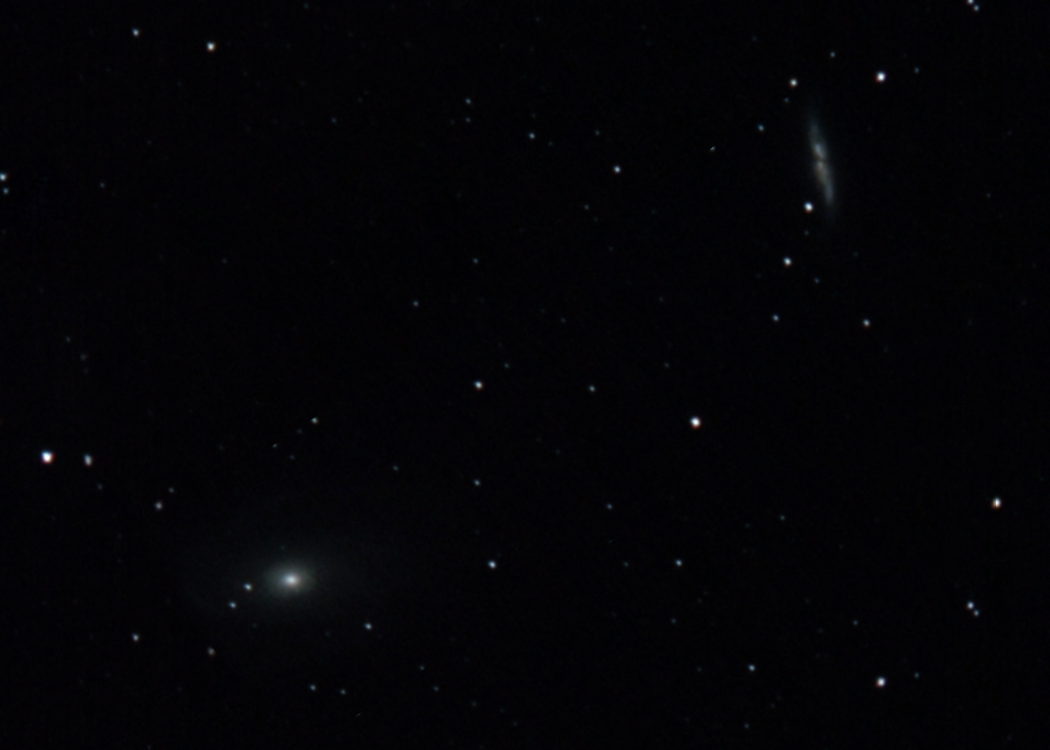
Faint fuzzies are how most people describe deep-sky objects and while I have to agree with this assessment, don’t let the name fool you, these objects are an amazing sight.  Two of the best ones to view in the winter sky are M81 and M82.  My 8-year-old sister Abby described the irregular galaxy M82 as looking like the number 1 in space.  What makes these two objects even better is that with wide enough field of view you will be able to view and compare these spiral and irregular galaxies at the same time due to their apparent location in our sky.   While no structural detail could be discerned from these two objects, knowing that you are looking at an object 12 million light years away and effectively looking 12 million years into the past is an incredible feeling.  Although I have to agree with Abby, seeing the number 1 in space was pretty cool too!

Visual representation of M81 & M82

Getting Back in the Game

About a year ago, I got back into astronomy.  What had been a hobby of mine since childhood had turned into a frustration over the years because of faulty equipment and a lack of knowledge to effectively view the night sky.  My first telescope was a present from my Paw Paw for Christmas in the mid 1990’s (Oh, Those Wonder Years).  It was a 60 mm refractor and the only memories I have of it come from viewing Jupiter, Saturn, and the Comet Hale bop.  My second telescope came in Christmas 2000.  It was a 4.5 in. reflector telescope that would serve as my main scope for ten years.

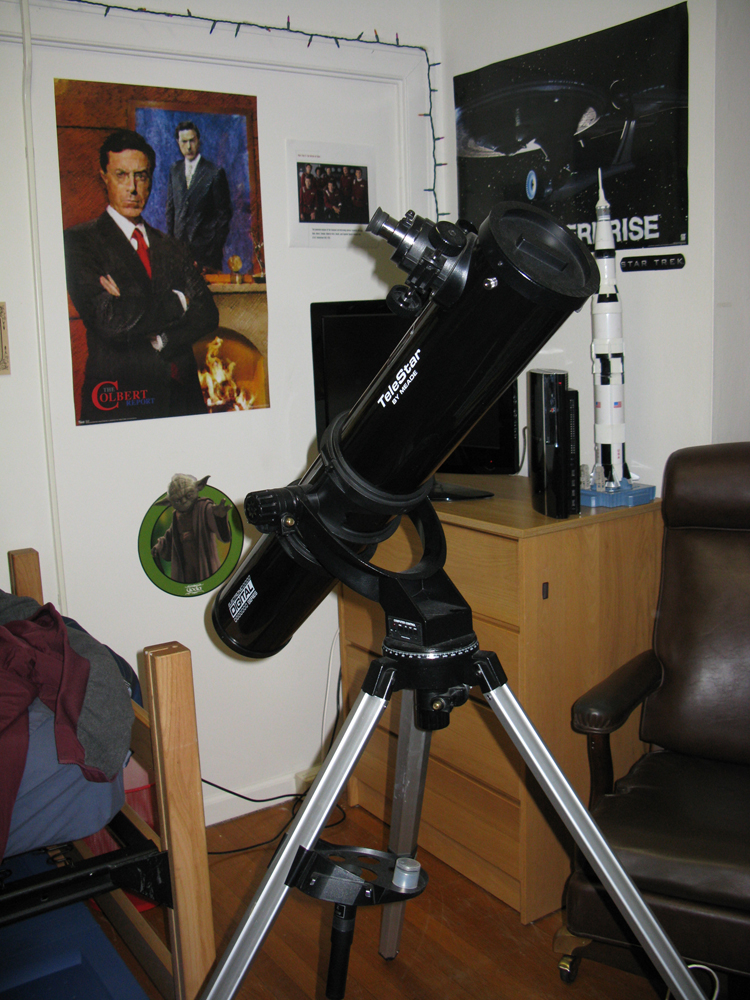
Meade DS-114 AT
Diameter-114 mm
Focal Length-910mm
(How many “nerd markings” can you find in this picture?)

As time went on, I would observe less and less with the DS-114 because of frustrations from its “goto” feature.  Considering my age at the time (13) a telescope with motorized features was probably not the best idea, but boy did it look awesome set up in my room.  As the years went on, I would occasionally take the telescope out on a summer night to view the moon or randomly scan the sky.  Once, I remember coming across a group of spectacular spiral galaxies, but those “accidents” were few and far between.  Fast-forwarding to the winter of 2009, I had pretty much abandoned astronomy, while the interest was still there, I began to see it as a thing of my past.  That is, until one cold winter night on the tennis courts of Roanoke College.

I had recently decided to fetch my telescope from the basement of my parents house during Christmas Vacation from college.  I dusted the old lady off and to my surprise, all of the eye pieces were there and the telescope was in good condition.  Bringing it back to the college, Lauren and I decided to take it out onto the back tennis courts on a clear and cold December night.  After removing the “goto” motors (apparently it wasn’t my age, they are just crap), I moved the telescope by hand as best I could, the motions weren’t exactly smooth but never the less it was a great improvement from the battery draining, slow-moving motor system of the past.  About an hour had passed, the cold weather was starting to get to us and then a star caught my eye.  It had a dull orange/yellow glow to it.  While it was not the brightest star in the sky by a long shot, something just look different about it.

I pointed the telescope, looked through the eyepiece and was shocked to see a small ball with rings.  Lauren and I had discovered Saturn (Yeah I know that boat sailed a long time ago) but it felt like we had discovered Saturn for the first time.  This was the first time I had viewed the ringed wonder in a couple of years and I felt the joy and excitement that I remembered as a child trying to find objects in the back yard with nothing more than a “goto” telescope that didn’t really work to well and some star charts I had no idea how to read.  It was this moment that sparked my re-interest in astronomy and led to my search for a new telescope that would allow me to easily find and study lunar and planetary details as well as deep space objects.  The journey had begun and the hunt was on for what would be a nearly year-long quest to find the perfect telescope.

Michael

Clear Skies Are Back

Warm weather and clear skies have finally moved into the Roanoke area.  (Warm weather of course meaning temperatures in the high 30’s)  After weeks of nasty snow storms and consistently cold weather “Clear Skies Are Back”.  With this warmer weather comes the opportunity to finally extensively use my Orion XT8i Telescope.  I’ve only been able to use my telescope a handful of times since Christmas.  This Saturday proved to be a good test of its abilities.

After seeing some very interesting plays done on campus (Yeah, I’m talking to you crazy, murdering, lesbian lovers) Saturday Night’s line up for Lauren and I included Mars and Saturn.  I have viewed all of these objects before with this telescope but not with a 2x barlow lens to really push the magnification.  Thanks to a gracious professor at Roanoke College who allowed me to borrow the lens, I was able to view Mars and Saturn for the first time at 240x magnification.

Mars:
Lauren and I were able to make out some very distinct land features on Mars that we had never seen before.  At the previous 120x magnification, I could make out the polar ice caps and some subtle hints of land features.  With the 2x barlow lens added Lauren and I were both able to clearly make the Northern ice cap but more amazingly dark land features, specifically Syrtis Major, which is a low-level shield Volcano remnant.  Lauren described it as looking like a dark spot and I thought it looked like Africa.  Here is a good representation of what we viewed.


Saturn:
Following Mars we viewed the always  beautiful Saturn a little after midnight.  Saturn’s Rings are at a fairly flat viewing angle (equinox) to Earth for the next couple years but Lauren could make out a little bit of the divide between the rings and the planet.  We could also make out 4 of Saturn’s moons including the impressively bright, Titan.
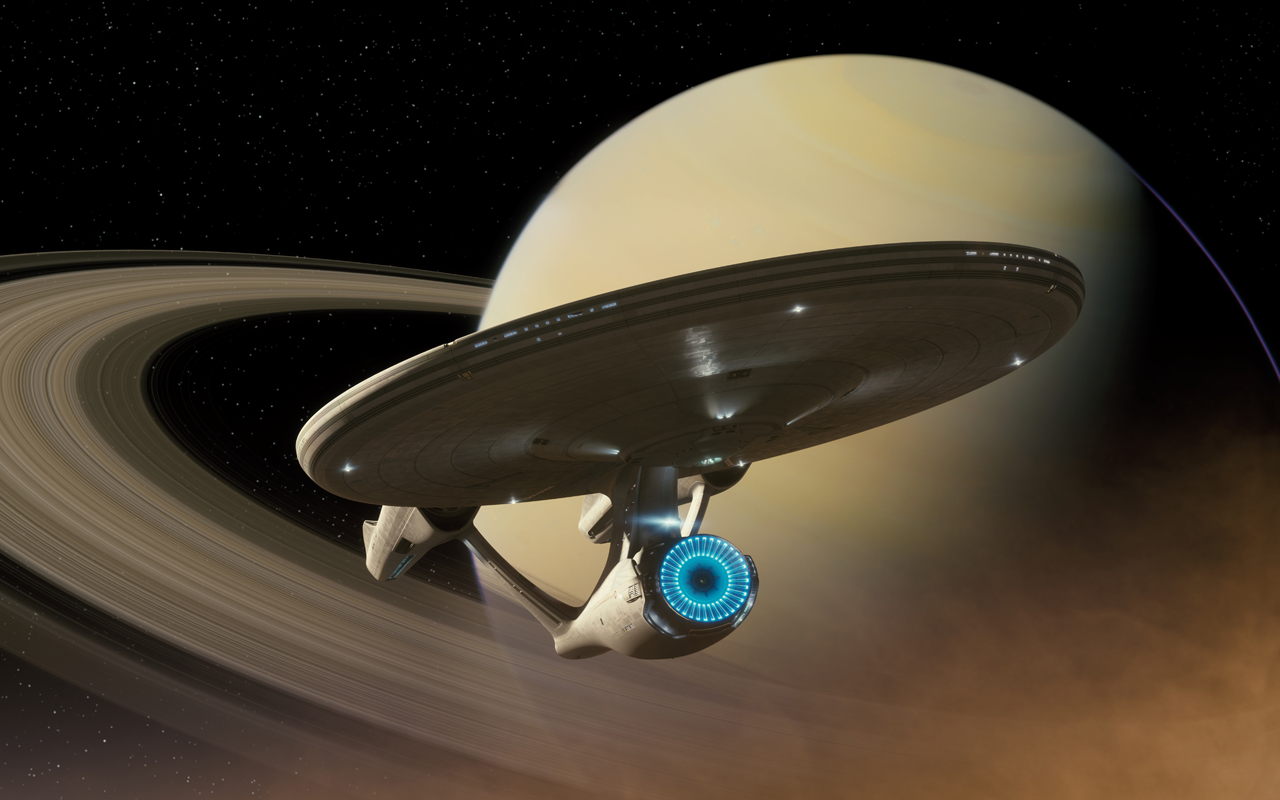
Here is how Saturn looked, needles to say it made my night!  And yes the Enterprise was there, I swear
(Don’t ask Lauren)

All in all it was a very enjoyable night out on the Front Quad of Roanoke College.

PS-Thanks to all of you who took great concern in seeing my telescope out by itself with a sticky note on it reading “Be Right Back” (The first time I took it out on campus it had three sticky notes on it “Do Not Touch” “College Property” and “Under Servelance”)
Yeah, I know it was spelled wrong!

Clear Skies All,
Michael