The Great Red Spot of Jupiter

At 3:40am, a noticeable blob peaked its way into view moving across Jupiter’s surface.  Located where the missing southern cloud belt should have been, it became apparent very quickly that this was something I had wanted to view since childhood.  The location and size left no doubt that this was the Great Red Spot (GRS) of Jupiter.

Earlier views of Jupiter around 3:00am had shown the basic cloud belts, but its fast 10 hour rotation (Jupiter day) brought about new features quickly.  With a size between two and three times that of Earth, it is the largest storm in the solar system.  Over the past couple hundred years the GRS has varied in size and faded in and out but has constantly remained one of the most interesting features to view in the solar system.  To help with observing, I found putting half of a polarizing filter on my eyepiece cut down on the glare (I’ve also found that a full polarizing filter works as well and can be adjusted to best effect).  This reduction in brightness, brought much needed contrast that allowed another smaller blob to pop into view just to the lower left of the more massive GRS.  I’m not sure if this was Red Junior (GRS’ little son) or just a random cloud system near by.  Another first, came from noticing the inconsistencies of the cloud belts.  What had appeared as straight lines in the past revealed themselves to be imperfect clouds with wrinkles and folds.  Finely tuned optics, enough cool down time and waiting for pristine moments of atmospheric conditions will help to reveal details such as these .  Excited at seeing this type of detail at 120x magnification, I went inside and brought out a notepad to sketch the features I could make out.
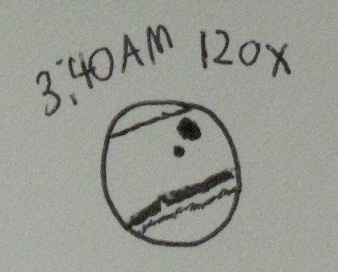
Not every night do I get to view something that I have wanted to see since childhood.  Reading books and seeing videos of the Great Red Spot when I was a kid always made me want to view it.  Even if it does appear smaller with less detail and color, nothing can replace the feeling of excitement in knowing that you have viewed the largest storm in the solar system with your own eyes.

Star Log: July 15, 2010
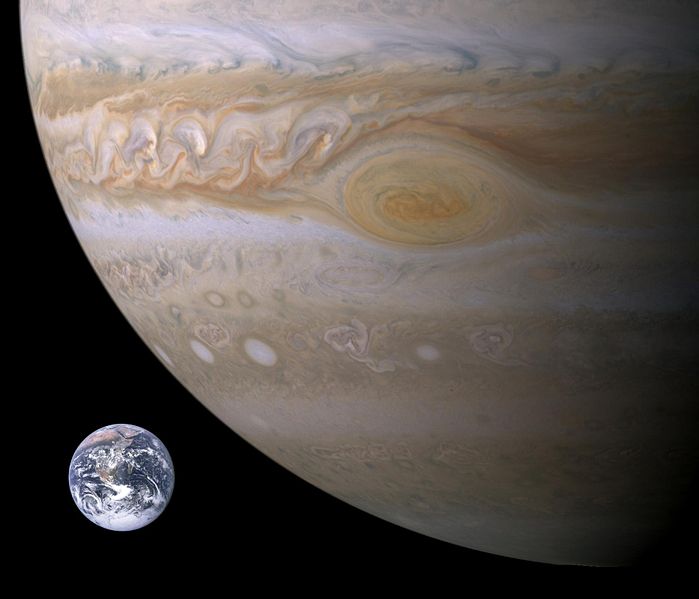
Here is a visual of the size of the Great Red Spot compared to Earth and a  representation of what I saw through my telescope.
Breaking News: Mars will not be as big as the Moon in August

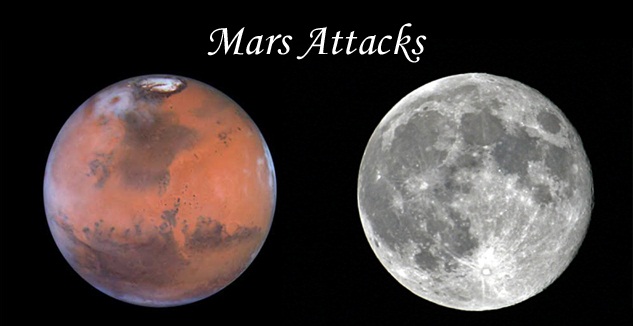
Over the past two days I have had two people ask me about an e-mail they recently received dealing with Mars.  The message said that a once in a lifetime event was about to occur, where Mars was going to be a thousand times bigger than it normally is and appear as large as the Moon, this August.  It seems that around this time every year the e-mail is forwarded around in preparation for the big August event.

Simply put, the e-mail is a hoax, but with all rumors and conspiracy theories, there was a slimmer of truth back when it was first written that keeps it popping up in people’s in-boxes today.  The message began as a hoax back in 2003, when in August, Mars made its closest pass to Earth in nearly 60,000 years.  The thing is, that even at this “close” distance, Mars still just appeared as a dot in the sky, all be it a much brighter dot, but still no bigger or brighter than the brightest star in the night time sky.  To capitalize on this event, the e-mail hoax began of Mars being literally as big as the Moon in the night sky every August.

In reality, every two years, Mars and Earth are at opposition, meaning that they are at their closest point to each other in their orbit around the Sun.  This past January and February, Mars and Earth were in opposition, giving some spectacular views of the land features and continents of the planet. (February Mars Report)  Even at this close approach and at 240X magnification, Mars still didn’t appear any bigger than the tip of your pinky finger held away from you at arms length.

Well, I hope this clears up some of the confusion about the e-mail, if any of you receive it.  Until next time, thanks for reading and no matter what your going through in life, keep your feet on the ground and keep reaching for the stars!
Michael

Hercules, Milky Way, and Bats! Oh, My!

We all have prejudices in one form or another.  One of mine happens to be my preference of open clusters over globular clusters.  While this may be true, tonight I take a slightly different position.  For I have viewed the king of the globs and it’s elegance made me question my own beliefs and gave me hope that I could move beyond my mindset concerning the faint balls of fuzz known as globular clusters.

The Hercules Star Cluster
M13, otherwise known as the globular cluster Hercules, is quiet a sight to be seen.  One of the reasons I have always preferred open clusters to globular clusters is that the individual beacons of light in an open cluster makes them look as though someone spilled a bag of fine jewels onto a black table.  Hercules seemed to give the best of both worlds as its soft fuzzy core revealed pinpoint stars moving out from its center.  Looking at it in different ways and focusing it slightly different appeared to reveal different details in various areas.  Moving from 48 to 120X magnification helped to bring some finer detail to the core of it, all be it at the expense of brightness.  I would have to rate this globular cluster as one the most impressive I have viewed to date, even exceeding M3.

The Rise of the Milky Way
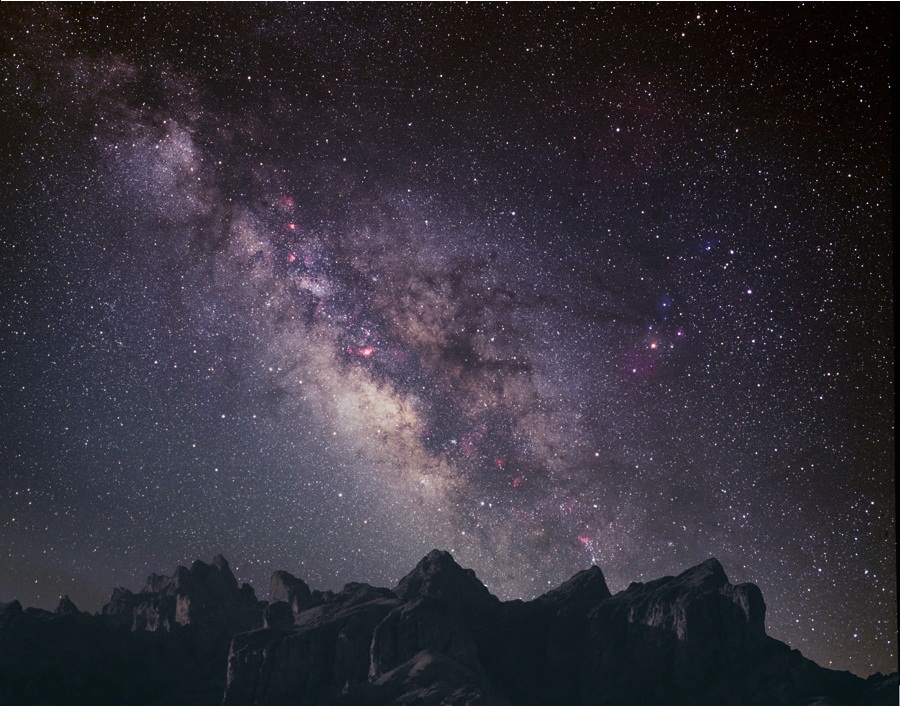
As the night progressed, the Milky Way parked itself right overhead and its brightness and dense patches of stars proved why ancient people thought of it as a milky and dense mess.  I have read where people have viewed it rising from the horizon and wondered if clouds were coming in to spoil the views of the night.  Knowing that when we look into the Milky Way, in the summer night sky, we are taking a rare peak into the center of our own galaxy is one of the things that puts me in awe of our small little home on the outer bands of the Milky Way Galaxy.

The night ended with Lauren and I lying on the trampoline and talking.  As we looked for shooting stars, I noticed a couple of satellites passing over, sailing smoothly through the nighttime sky.  It was a very peaceful end to a good day until a bat began swooping down near us.  It startled us at first (well, mainly just me) and as it came down for another pass, I jumped up yelling and ran off the trampoline falling off of the chair that helps us to get down and staggered off towards the house.  All the while Lauren remained laying on the Trampoline (this really helps to explain the dynamics of our relationship)!

Star Log: June 5, 2010

The Good Ole Southern Sky

You would think that after a few months of putting the telescope in the same place every night, I would have thought to move it to reveal a different part of the sky.  Trees generally block my view of the far South, but tonight I switched things up and moved the telescope next to my parents new 2010 Dodge Minivan (this thing is like the space shuttle, it has awesome features).

Finding Pluto…Yeah Right
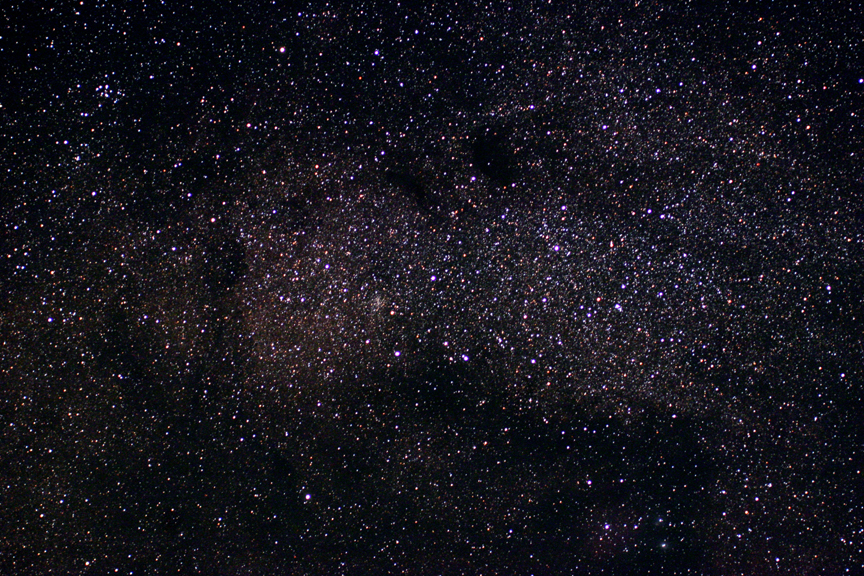
The initial goal for the evening was to hunt down Pluto, located to the South a little bit above Messier 24, the great Sagittarius Star Cloud.  That was until I viewed M24 and realized how dense it was with stars.  I might have actually viewed Pluto tonight, but it would be near impossible to know which of the thousands of stars I was looking at was everyone’s favorite dwarf planet.  Talk about finding a needle in a hay stack, this picture of the star cloud to the right shows how difficult a task it was.

The Messier Bunch
While planning the night, I noticed that Pluto was near a few Messier objects I had never viewed.  This would be a perfect opportunity to check off some more objects for my ultimate messier hunt.  Located to the South West of Sagittarius were the Eagle Nebula, Swan Nebula, Sagittarius Star Cloud, Trifid Nebula and the Lagoon Nebula.  All were a treat to view, with the exception of the Eagle Nebula, which I had a particularly hard time making out for some reason.

The Lord of the Ring

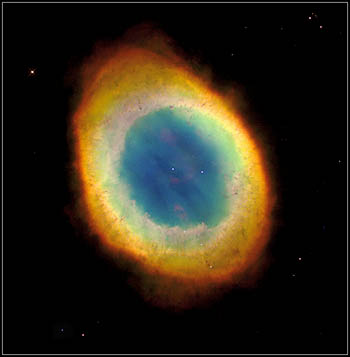
Nothing tonight compared to the spectacular view received by viewing Messier 57, the Ring Nebula, for the first time.  It appeared as a very defined circular cloud of smoke with a gray hue in the center.  Viewing at 120X magnification revealed it’s circular definition even further (A good example of what I viewed can be found to the left).  Its defining shape comes from a star, very similar to our own sun, that has used up all of its hydrogen and is shooting gasses out into space as it dies and becomes a red giant.  While, most nebula’s have the same faint cloud like shape, the Ring Nebula is something truly unique that seems as though it was stamped onto the sky.

Star Log: July 10, 2010

Hubble Space Telescope Image of the Ring Nebula

(Just a little better than what I saw….a little)

A Strongly Worded Letter

Warning:
The following views expressed are made by an overly cautious person.
They do not represent the management or staff of Late Night Astronomy.

A few weeks ago, I was shopping in our local Dollar Tree and noticed a telescope for sale.  For the most part, it was your regular twenty dollar department store scope, but something was a little different about this one.

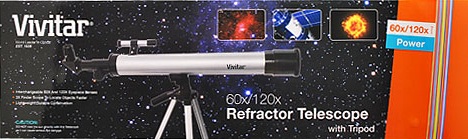
You see, when department store telescopes are packaged they tend to come with elaborate pictures of the moon, planets or galaxies signifying to the buyer that you can see this through the telescope.  The problem is you can’t.  Those pictures were taken by the Hubble or some other high dollar telescope, which leaves most people confused and frustrated that they can’t see the quality that is displayed on the box (I’ve fallen for this before, with a scope I got from Wal-Mart).

However, something was even worse about this telescope’s packaging.  This box had a picture of a nebula, a close up of a satellite and a picture of the Sun.  That’s right, the Sun!  I laughed at how ridiculous it was to put a picture of the sun on it as an object that could be viewed and then I got a little concerned.  I started to think about “little Jimmy” who comes into the store and gets his parents to buy him the telescope that has a nice big picture of the Sun on it and decides to go out and do some viewing during the day (This is how my mind works).

So, I decided to write an email to Vivitar, the company who sold the telescope.  Seriously, I wrote them an e-mail, this isn’t a joke!

I noticed in a store today that your telescope has a picture of the sun on the box.  I thought this might send the message to some kids and adults that it would be fine to look at the Sun through the telescope.  If a person were to do this it could lead to serious eye damage or blindness as I’m sure other warnings in the instructions inform the buyer.  I don’t mean to ridicule your product and I’m sure your company meant nothing by this picture being added, I just thought I would point out that it might not be a good idea to put a picture of the sun on a telescope box for people as they might think this makes it an object that can be viewed by the telescope.

Have a nice day,

Michael Martin

Yep, its hard to tell how many thousands of children’s eyes I saved with that e-mail.  All in a days work I suppose, all in a days work!

The culprit!!!

All 8 Planets, Present and Accounted For

Hanging out with Lauren at four o’clock in the morning can only mean one thing…telescope time.  Before you pass judgment on my late night priorities, let me mention that on this night Jupiter, Uranus and Neptune could all be viewed in the night time sky.  See, I knew you would understand!

Jupiter
Looking to the east, right over top of our trees revealed the very bright, Jupiter.  I have viewed the king of planets once before with the XT8i, but the conditions were so cold and windy that I saw nothing but a hazy blur.  Tonight, the view was drastically improved.  The interesting thing about viewing Jupiter right now is that one of its cloud belts is missing (more about that, in this CNN Article)

Only viewing one cloud belt instead of the typical two, made Jupiter look oddly alien (pun intended).  Little fine detail could be picked up because of Jupiter’s low level in the sky, which created poor atmospheric conditions and because my scope hadn’t had proper time to cool to the outside air.

Uranus & Neptune
Having never observed these two, I was eager to complete my list of planets viewed in our solar system (My apologies to Pluto Lovers).  Uranus, no laughs please, was just to the upper right of Jupiter.  Finding it was easy and the light blue star, while a bit unspectacular was nonetheless exciting.  At 120X magnification, I wasn’t sure if I could make out a small sphere or not.  Neptune proved to be much more of a challenge to find.  Using Distant Suns Lite (the best free iPod Touch astronomy app) I was able to star hop from the constellation Capricornus to Acquarius, which led me to our outer most gas giant.  Neptune appeared nothing more than a somewhat bright medium range star.  However, the hunt to track it down and knowing that I had now viewed all planets in the solar system made it a much more exciting object to view.

Calling it a Night
With our lack of sleep catching up to us and a really creepy person walking in the road with no flashlight at 4:30 in the morning brought our night to an end.  As we were heading in, I noticed a dim light coming from the distance, I asked Lauren what she thought it was and she said “probably the Sun”.  Right she was, as the rays were beginning to illuminate the night sky with the hope of a new day at the dawn of the new light.

Star Log: June 20, 2010 (4:00am-4:30am)

The Conjunction Continues

Trees in my backyard can make positioning for objects quite a task.  As was the case with Mars and Regulus on this night.  Just above the mountains to the East lied the stellar pair who only had about 30 minutes of visibility left for the night.

Bringing out the scope, Lauren and I placed it on the edge of my neighbors yard.  Right at that moment a light came on in their house followed by a flood light in the front yard.  I (always being the calm and collected one of the relationship) started to freak out and was motioning and mouthing quietly for Lauren to quickly help me move the telescope across the road (you would have thought they had run out with a shot gun and guard dogs).

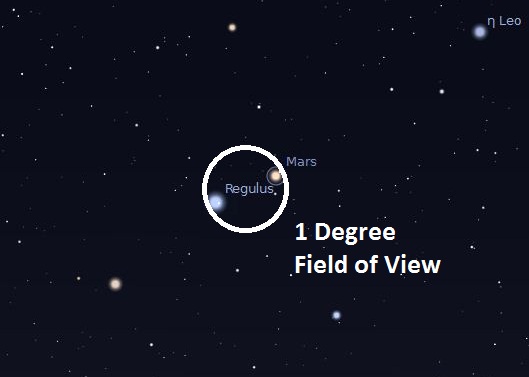
After moving the scope back to the edge of another neighbors yard, the eyepiece (to my surprise) revealed Mars and Regulus just barely in the field of view (FOV) of my 25mm plossl.  The pair appeared slightly distorted, being on the extreme edge of the FOV, but the white/blue glow of Regulus contrasted sharply with the red glow of Mars.  With the FOV of my eyepiece being  1.08 degrees, Mars and Regulus must have been exactly 1 degree from each other at midnight.

Mars and Regulus at Midnight, June 6th

Star Log: Midnight, June 6, 2010

The Conjunction Junction…of Mars and Regulus

“Conjunction Junction, what’s your function?  Hooking up words and phrases and clauses!”

“Conjunction in Space, what’s your function?  I’m a cosmic rendezvous in which two celestial objects appear to be close to each other even though we’re still hundreds of light years away.”

Looking up into the night sky over the next few evening will provide a splendid treat for those interested in somewhat rare space happenings.  From now until June 10, Mars and Regulus appear to be on a collision course (in actuality Regulus is 77 light years away from Mars).  As Mars approaches Regulus, they will appear closer and closer until Mars passes and moves away from its celestial neighbor.

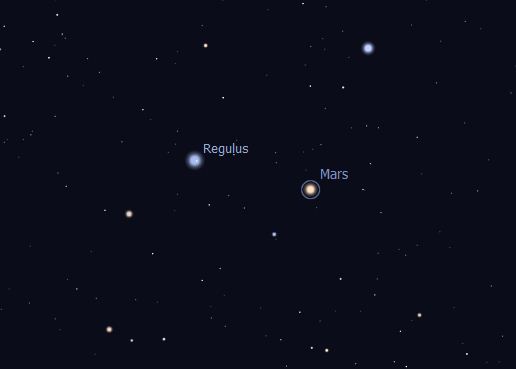
After just getting in from a dewy, yet clear night (the first nice one in quite some time) I took some observations of Mars and Regulus.  Currently, they are about 4 to 5 degrees apart.  I Measured this by clenching my fist and holding it out, this is roughly ten degrees of distance.  Each night should bring the two objects noticeably closer, until they reach their closest point on June 6.

Here is a diagram from Stellarium of what I saw tonight!

I guess School House Rock can explain anything!
Now, if only I were allowed to produce their next video, imagine the possibilities.

Special Note-While viewing a galaxy tonight at 48X magnification, I witnessed a satellite travel through my field of view followed by another no more than 10 seconds later traveling in the exact opposite direction.
Very strange and surprising!

“Four for Nine” Star Log: April 2, 2010

There are nine planets in our solar system (Yes, I said nine! You got a problem with it?)  Of those, I have viewed six; Mercury, Venus, Earth, Mars, Jupiter, Saturn (Surprisingly, Earth is best observed with the naked eye or a microscope)  Most nights will bring one or two planets into view; tonight, however brought four.  The first two are Mars and Saturn, easy to pick out and high overhead as the hours grow late into the evening.  The other two, are much more difficult because of their close proximity to the Sun.  This makes them viewable in small windows of time throughout the year either directly after sunset in the West or soon before sunrise in the East.  These two planets are Mercury and Venus.  Since I enjoy sleep, I try to view these two planets whenever it is possible following sunset.  Tonight would be one of those windows of opportunity.  With Alston and Abby visiting the college for the night, a quick view of Mercury and Venus would be in order before a night of wild partying and crazy antics.

Mercury & Venus
As Abby, Alston and I were walking around the campus on a beautiful Friday evening, Venus popped out from the darkening blue sky, faintly revealing itself amidst some light clouding near the horizon.  Walking back around to the telescope set up next to the Administration building, Mercury appeared in the sky, slightly to the South East of Venus’ position.  The views of these two planets were largely unimpressive because of their low levels on the horizon, the telescope not having proper time to cool down and their positioning right over a building’s roof that was releasing heat.  The best resolutions of these two planets on this night, revealed nothing more than wavy blobs of light.  None the less, this was my first observation of Venus and Mercury on the same night, and that in and of it self is a rare occurrence.

Update: Two nights later on Easter Sunday, I was able to view Mercury and Venus once again, this time from my parents home in Clifton Forge.  Conditions were much better for observing on this night allowing Mercury to reveal itself as a small crescent moon looking object.  This detail in Mercury really surprised me and although the images of it and Venus, which is currently not showing much of a shadow, were still a bit wobbly from the atmosphere and heat rising from roofs of houses and the street, being able to make out discs for both and shadow detail on Mercury was pretty amazing!

Visual Representation of Mercury and Venus’ Position:

Following Mercury and Venus, we came back out a few hours later to observe Mars and Saturn, making that four out of nine planets viewed in one night.  Getting to hangout with Alston and Abby was a blast.  When I asked them what movie they wanted to watch Abby said “How ’bout Star Trek” to which I thought to myself “Awesome”.  We went to Sheetz later in the night with Alston and Abby ordering a double bacon biscuit (mmm…bacon).  A few games of “Modern Warfare 2” and “Little Big Planet” later it was time to call it a night.

Star Log: March 20, 2010

After a late Friday night, I awoke at noon on Saturday and walked over for brunch to find around a hundred people standing outside of the Colket Center with two fire trucks near by.  Thankfully all was well, save for a minor fire in the kitchen area.  Lauren returned from her trip to Boston later in the day and we went on a nice walk to an antique store in downtown Salem.  Upon returning to the dorms, I came across an internet article about the International Space Station and thought it might be a good idea to see if  it would be flying over anytime soon.  Surprisingly, later that night at 8:12pm it would be making a 5 minute fly over from North West to East South East, making  tonight a perfect opportunity for my first attempt at viewing the ISS through a telescope!

International Space Station Fly Over:
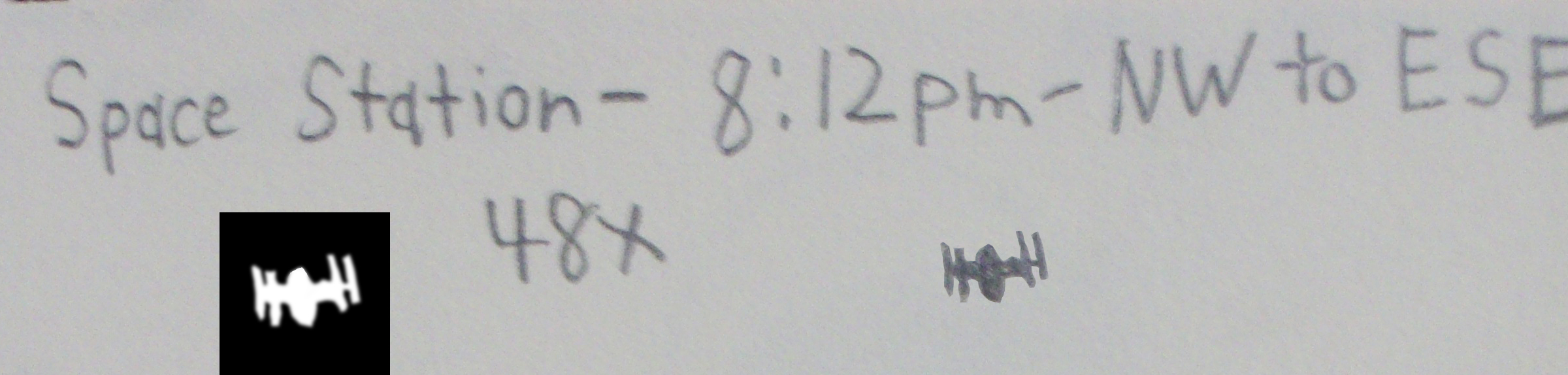
Around 8:00pm, my friend Andy and I set up the telescope on the back quad of the college.  The sun was setting and we had spent about a half hour observing the Moon.  A few minutes before the fly over, two men from  a music group called Barefoot Truth, who were performing on campus that night, came over and asked what we were looking at.  They took some quick views of the Moon and were very interested in seeing the ISS.  Around 8:11 the most beautiful thing I have ever seen in my life appeared from the distance, it was Lauren, who was fashionably late, showing up just seconds before the Space Station.  8:12 swings around and right on schedule a dim star appeared right above the Colket Center sailing across the sky.  It began faint but became as bright as Venus it passed over head.  Now came the hard part, attempting to view in through the telescope.  It can be difficult enough to find and track a slow-moving planet, never mind a football field sized Space Station moving at 17,000 mph and orbiting 200 miles above the Earth.  After about 20 seconds of attempts,  it finally became visible and flew through the field of view in less than a second, looking like a very bright blur.  At this point there were now 5 people hanging around the telescope and all got at least a split second view of the space station through the eye piece while I tracked it through the finder scope.  As it continued to move across the sky one more attempt was given to actually try to keep it in the eye piece’s field of view for an extended period of time.  This was accomplished just as the Station was near its highest point in the sky and through tracking it for around 5 to 10 seconds the bright blur that had been viewed earlier turned into a detailed object.  At 48X magnification,  the pods in the middle where the astronauts are located were somewhat visible, but more amazingly and sharp were the two sets of solar panels on both sides of the Space Station.  The way is which the Station glowed with brightness, particularly the inner pods, along with the detail that was discerned from its solar panels truly made this one of the most memorable experiences I have ever had in astronomy.

Sketch of the ISS as viewed at 48X magnification:

Later in the night, Mars, Saturn and the Moon would be observed, but none of those objects could hold a candle to the couple of seconds spent viewing the Space Station with its inner pods and detailed solar panels.  Never before have I observed an object in space that has people working and living on it through a telescope.  As we looked up and saw the Space Station sailing across the night sky, I couldn’t help but wonder if one of the astronauts was looking down at us here on Earth.  Hundreds of thousands of people have seen the Space Station at night, whether they realized it or not.  My guess is that only a few thousand have observed it through a telescope.  After tonight you can add Lauren, Andy, two guys from Barefoot Truth (thanks for the free CD’s, by the way), a random college employee whose name I didn’t get and myself to that list.

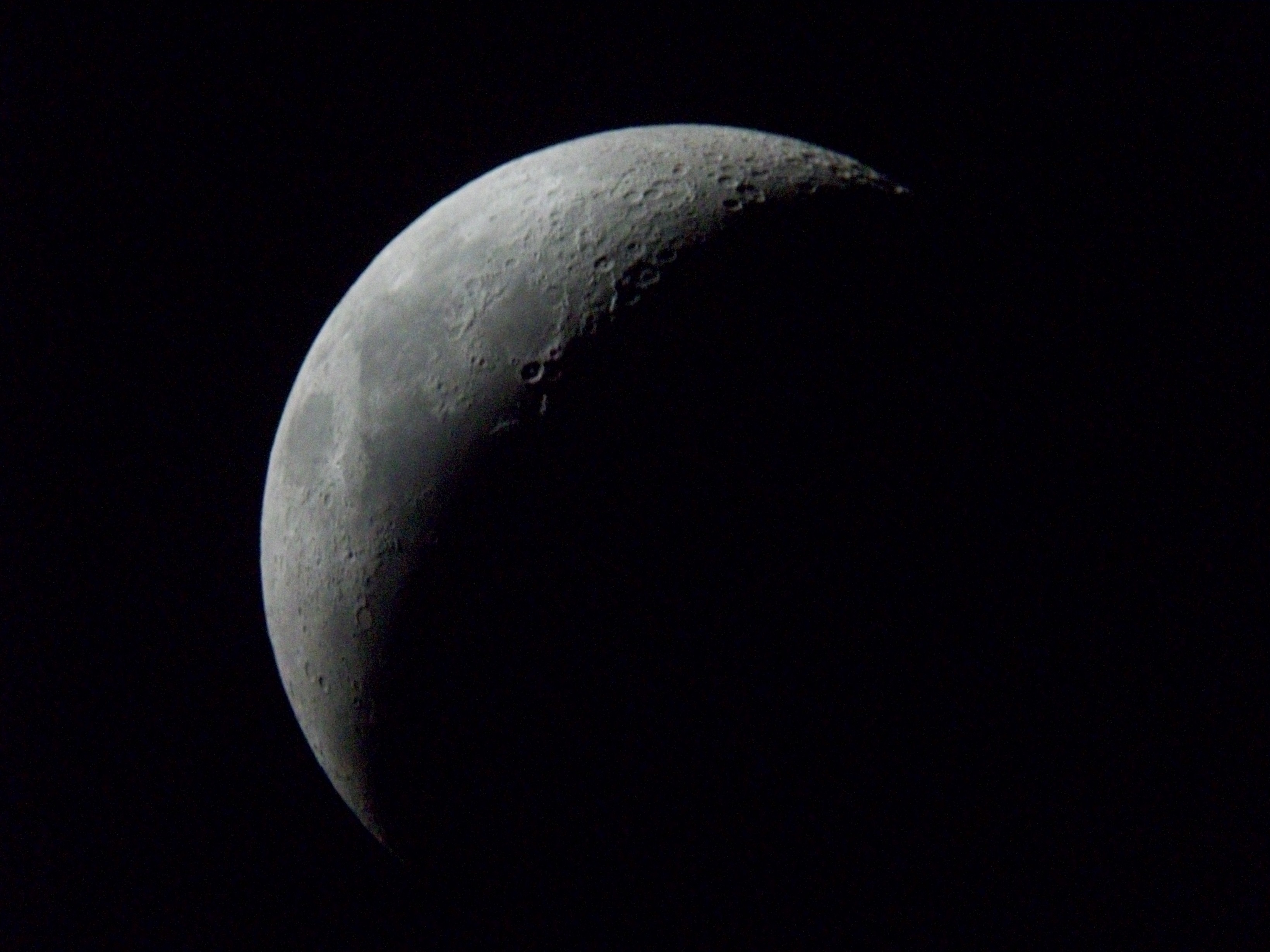
Pictures of the Crescent Moon, taken on this night, complements of Lauren: