Imaging the Pleiades Star Cluster with the Skyguider Pro

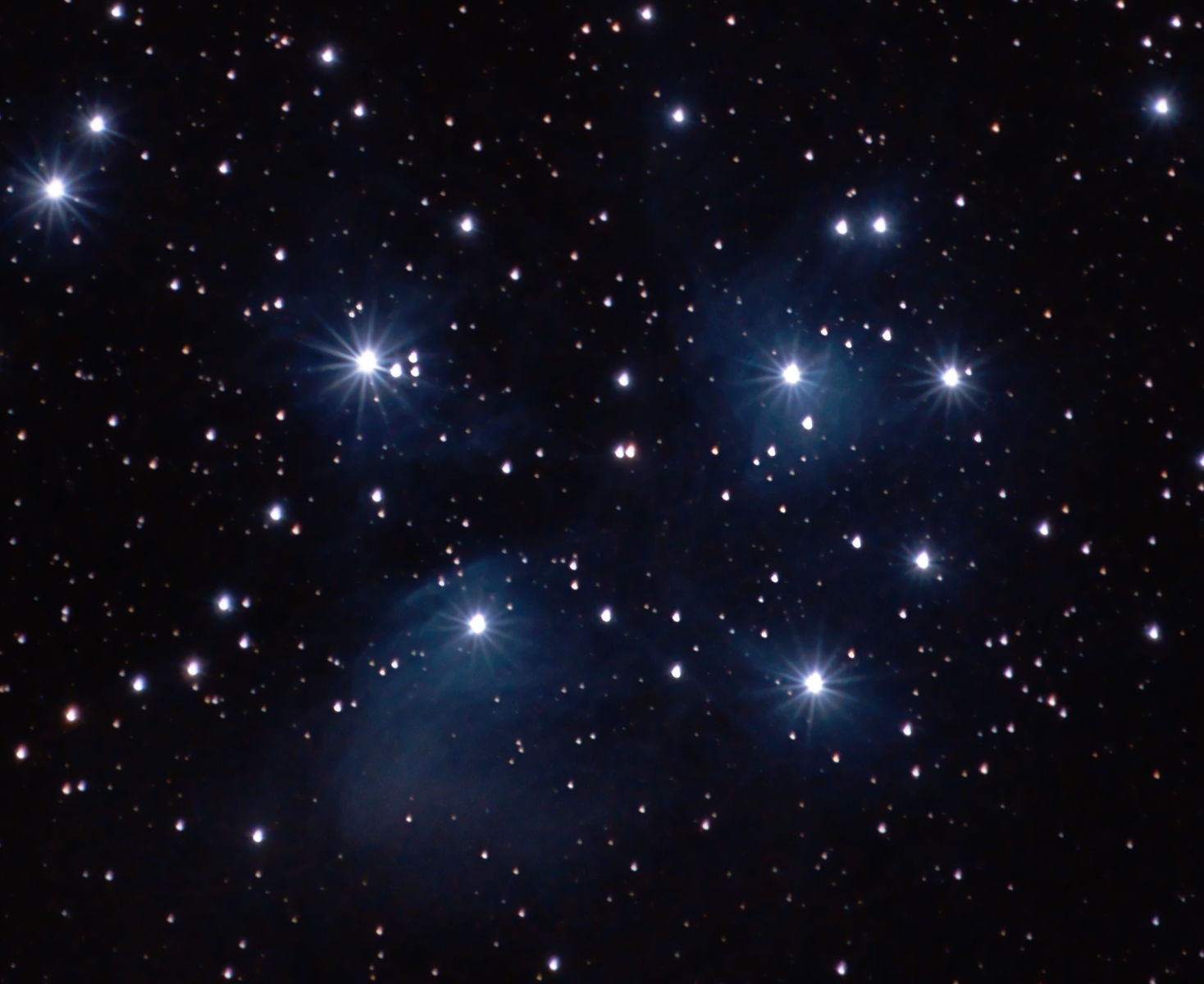
With one hour and twenty minutes of exposure and several hours of processing, I have finished my work on the Pleiades Star Cluster. Also known as the seven sisters, its stars are surrounded by blue nebulae, which are difficult to see in a telescope but easily visible through long exposure photography. As the blue stars move through these dust clouds, their light reflects off of them creating the nebulosity in this image. I am really pleased with the faint details of the clouds and their complex structure.

Pleiades Star Cluster


Completing the Messier List

IMG_4007

The Final Two!

M74-The First Attempt
With two dim galaxies left to go on the Messier List, I arrived at Back Creek Valley Overlook around 8:15 PM to skies that were clear and steady, ranking a 6 for transparency and very good to excellent for seeing conditions. I first turned my attention to M74, one of the dimmest and most difficult objects to view on the Messier List. The pattern of stars were right where they should have been, but no M74. After a few more failed attempts, I decided to move on to my other object of the evening.

M74

Where are you?

M33: The Triangulum Galaxy
The Triangulum Galaxy is massive and, due to its size, has a low surface brightness. A 2 inch eyepiece providing 32x magnification gave the best views of this large galaxy, which was easier to distinguish from the background sky than I expected. With M33 documented, I now was down to my final Messier target, but the surprising ease of observing the dim M33 made me concerned that M74 wasn’t going to show itself tonight. 
IMG_4017

Easier Than Expected!

M74-The Final Attempt
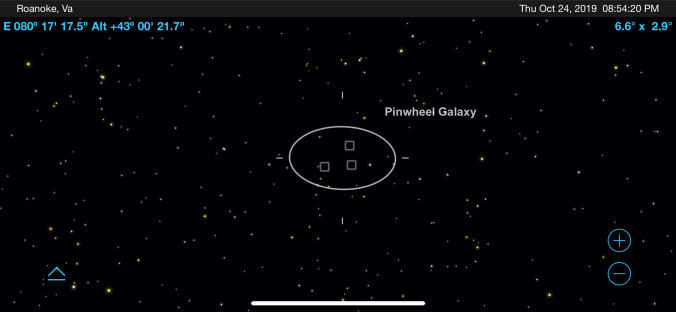
If M74 wouldn’t show itself under these ideal seeing conditions, I had two options. Drive to a darker location or use a larger telescope next time I was observing with friends. I didn’t feel like driving any farther tonight and was determined to get all of the Messier targets with my own 8 inch Dobsonian. Around 8:30 PM, my attention turned exclusively to observing M74, and it still wasn’t showing itself. After about 10 minutes of attempts, I thought some faint signs of cloudy detail were possibly coming through, but it was nothing I was comfortable with documenting as a sighting. I then spent the next 15 minutes with a sweater draped over my head to create a “dark room on the Parkway”. Going between 48x and 96x magnification, some more stars slowly started to appear where just a few minutes before there was only darkness. Finally, around 8:50 PM, my “darkroom” was paying off, and the ghostly smudge of a galaxy core began to lift itself out of the background of space. With the extremely faint smudgy core of M74 now appearing exactly where it needed to be on my star chart, I documented my last Messier target at 8:54 PM on October 24, 2019.

After 27 separate observing sessions spanning nearly two and a half years, my journey through the 110 objects that make up the Messier List fittingly ended on two dim fuzzy galaxies viewed from the Blue Ridge Parkway. Here are some stats regarding my time observing the Messier List.

The Messier List
Project Began: June 11, 2017
Project Completed: October 24, 2019
Time Elapsed: 2 Years, 4 Months and 13 Days

Observing Sessions: 27 Nights

Most Objects Viewed in One Session: 11
Averaged Viewed Per Session: 4

Objects Viewed from Home: 94
Objects Viewed from Parkway: 16

Favorite Messier Objects:
M6, M7, M11, M13, M17, M24, M27, M31, M37, M42, M45, M57, M67, M76, M81, M82

A Night Observing on the Blue Ridge Parkway

Of the seven Messier targets remaining, none can be viewed from my home and with time off from work coming to a close, few opportunities remain to complete the summer portion of my list. This was the setup for my trip to Back Creek Valley Overlook on the Blue Ridge Parkway July 28/29 from 10:45 PM to 12:45 AM.

Back Creek Valley

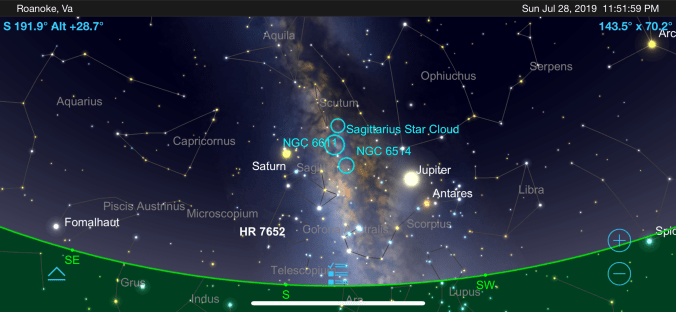
Jupiter can be seen in the top of the image!

Arriving at the site, I was relieved to see that no one else was present. This was my first time observing on the Parkway by myself. At first I was a bit uneasy, but after setting up and focusing on the targets of the evening, it was quite a peaceful experience. When I stepped out of my car the brightness and density of the Milky Way stretched from the dark horizon facing South to the Northern horizon where it was absorbed into the light dome of the city. It was a spectacular site that I have never seen stretched across the entire night sky.

Tonight’s Big Three: M20, M24 & M16
IMG_3559
Using Saturn as a starting point, I worked my way through the dense core of our galaxy first coming across M20, the Trifid Nebula. Trifid appeared quite dim with some visible structure and two bright stars right at its core. Even under dark skies this was a difficult target but averted vision did help to reveal some of the famous cracks in its core.  M24, the Sagittarius Star Cloud is one of the few Messier objects that I have needed to use a 2 in. eyepiece to properly observe. The wide field of view revealed the stunning density of this cluster. Viewed from the Blue Ridge Parkway, it was much more impressive than at home. M16, the Eagle Nebula was the most difficult target to view this evening. It was actually more visible through my 9×50 finder scope than through the telescope. An O-III filter and averted vision helped to bring out the nebulosity and structure that surrounded several stars. As I worked my way up the core of the Milky Way I came across some objects viewed before but that were much more impressive for a darker sky location. The Omega Nebula was truly stunning and appeared to pop out from the background sky with a three dimensional quality and the Lagoon Nebula was a much more impressive sight than its nearby neighbor Trifid. Using the 9×50 finder scope and 2 in. eyepiece to slowly work up and down the core of our galaxy just to see what I would come across was one of the most unique observing experiences of my life.IMG_3561

Two More for the Night: M55, M72
Moving away from the Milky Way led me first to M55, a large but dim globular cluster appearing more like a round nebula. The size of this globular was impressive and some fine detail was apparent at higher magnifications. M72 was an unimpressive small and dim globular cluster with no fine detail.

The Final Two…
IMG_3563
After finding the five main objects for the evening I made an attempt at M33, the Pinwheel Galaxy and M74. Both were too low to the horizon for such dim objects. My plan is to come back to the Parkway in early November to observe them which would bring an end to my Messier list before the end of 2019.

A Trip to Jupiter

Jupiter's Transit of Io

Io casts a shadow on the surface of Jupiter.

Io casting an impressive shadow as it moves between Jupiter and the Sun. Tracking these transits across the surface of Jupiter is a really interesting observing opportunity and shows the ever evolving dance between Jupiter and it’s many moons.

Imaging Vega and Epsilon Lyrae with the SkyGuider Pro

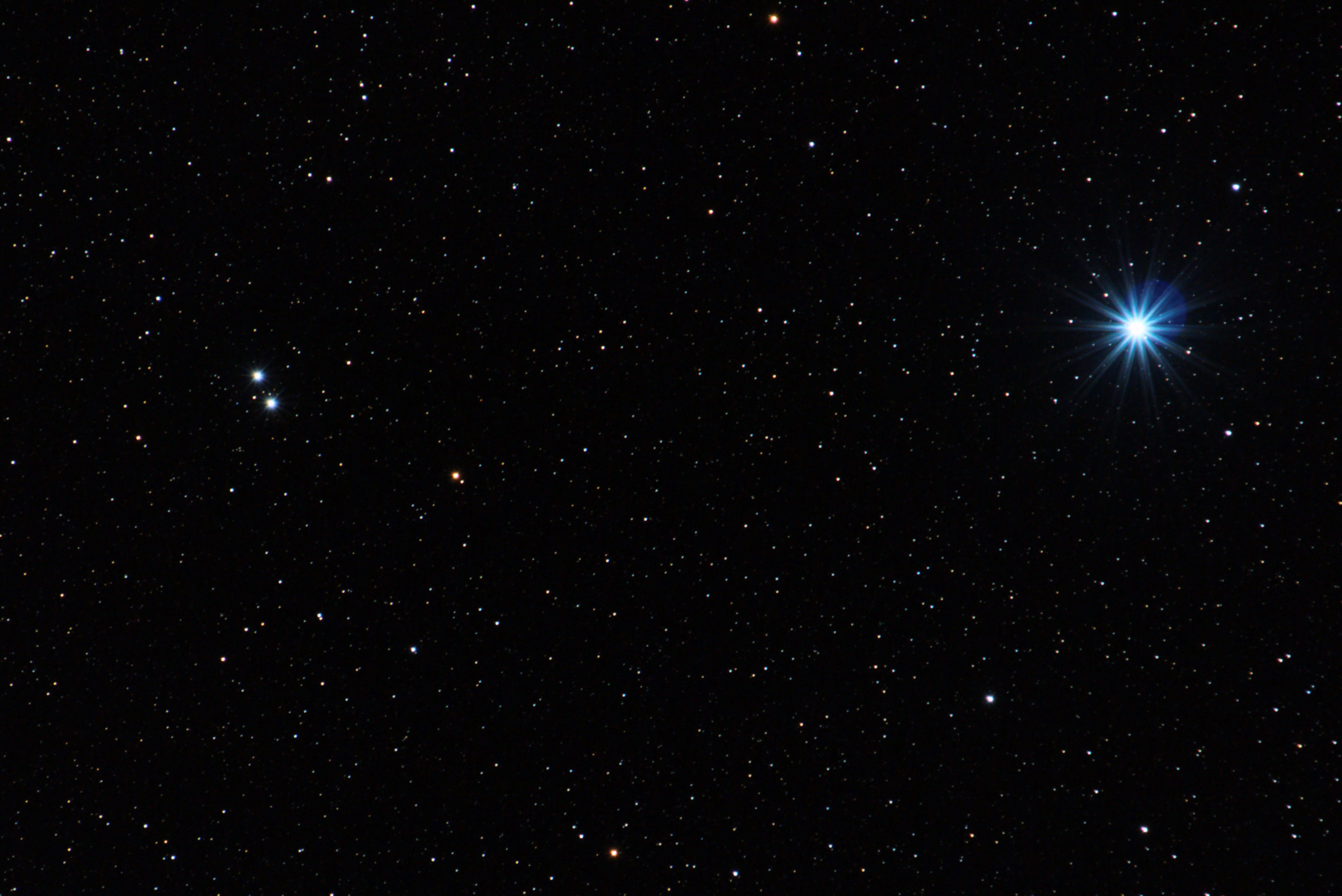
Vega is the 5th brightest star in the night sky and is located only 25 light years away. Epsilon Lyrae, otherwise known as the “double double” appears as four stars at high magnification through a telescope. Hints of the piercing white and crystal blue from Vega can be glimpsed through a telescope but it’s true elegance is revealed through imaging.

Vega and Epsilon Lyrae“The heavens declare the glory of God” Psalm: 19:1

The LEGO Apollo 11 Lunar Lander

The Saturn V Rocket was feeling a little lonely so I bought a companion. The LEGO Lunar Lander is a wonderful piece to commemorate the 50th anniversary of Apollo 11. Building these models gives an extra sense of satisfaction seeing them displayed. This will eventually be making it’s way to my desk at work come August.

Imaging the Great Globular Cluster in Hercules with the SkyGuider Pro

People image the night sky for various reasons. My two main goals are to share a small part of my experiences with those who may have an interest in amateur astronomy while also showing people the glory of God by way of His most magnificent interstellar creations.

Few objects check off both of those boxes as well as M13, the Hercules Globular Cluster. This “cloudy” cluster of hundreds of thousands of stars is one of the best shows our galaxy has to offer. Through a telescope, it appears as a dense core with fine pin point stars becoming more apparent as your eye moves slightly away from the core. What I did not expect from this imaging session was how prominent the colors of M13 would be. It’s core shows a gorgeous mix of white, amber and blue stars that appear from our perspective to fuse together from it’s gravitational lock.

Hercules 100% Cropped

The Hercules Globular Cluster

For more technical details on how this picture was captured, stacked and processed, please check out the Astrophotography page.