Don’t miss the first big meteor shower of 2021! I’ll show you when and where to look to see the Lyrids and give some tips on ways to increase the number of meteors you can see! Be sure to let me know about your questions and experience with the Lyrid Meteor Shower in the comment section below. Clear skies everyone!
I’ll take you through a step by step guide on how to use DeepSkyStacker to greatly improve your astrophotography by stacking Light Frames, Flat Frames, Bias Frames & Dark Frames. If you find this video helpful, please like it and subscribe to this channel, but most importantly, let me know of the programs, settings and techniques that work best for you in the comment section below.
April, May and June of 2021 have a lot to offer in amateur astronomy. From meteor showers, a lunar eclipse, the planets of our solar system and deep sky objects, regardless of what equipment you own or your level of experience, I’ll walk you through the best things to view in the night sky this Spring. If you enjoy this article please like it and subscribe to this channel, but most importantly, let me know what you’ve been able to observe or image in the comment section below. Now, let’s get started by talking about one of the most relaxing things in astronomy that you don’t need any equipment to see and enjoy, meteor showers.
The Best Meteor Showers for April, May & June 2021
The Spring sky has two main showers to mention with April hosting the Lyrids Meteor Shower which peaks on the night of April 21st into the early morning of April 22nd. To view it, go out after midnight, face towards the East and look for the bright star, Vega. In between Vega and the Hercules Constellation will be the point of the sky where the Lyrids will appear to be emanating from. These meteors are from the dust of comet Thatcher and streak through the sky as the Earth moves through their path every year around this time. While this isn’t the most spectacular shower of the year it is a reliable one and can provide views of 10 to 20 meteors per hour, however the Moon being out this year will wash out a few more of the fainter ones. Another shower this Spring comes from the material left over from Haley’s Comet. The Eta Aquarids Meteor Shower is a difficult one to see from my Northern Latitude but can put on a nice show particularly for those living in the Southern Hemisphere. Go out around just before Sunrise on the morning of May 5th and face towards the East. To the left of Jupiter and the Moon, you will find meteors appearing to come from the constellation Aquarius. Expect 5 to 10 meteors per hour from this shower in the Northern hemisphere, especially with the moon positioned near them this year but the farther south you live, the more meteors you will see, with numbers possibly reaching 20 to 30 meteors per hour. There are three things I would suggest when viewing a meteor shower to enhance your experience and those are location, comfort, and patience. First, if you are able, try to get away from large sources of light pollution, this will greatly increase the number of faint meteors you are able to see. Second, take a lounge chair or blanket so that you can lay out on the ground to enjoy the show. Binoculars and telescopes are not needed because you will want to view as much of the sky as possible. Lastly, give yourself at least one to two hours of observing time to relax and enjoy the show.
The Best Views of the Moon for April, May & June 2021
April, May and June offer some wonderful opportunities to view our closest neighbor, the Moon, including an impressive Lunar Eclipse for some of us. But before we get to that, let’s look at the phases of the Moon and the best times to observe it. April starts off with its new Moon on the 11th and Full Moon on the 26th. For May, the new Moon will be on the 11th and Full Moon on the 26th. June sees its new Moon on the 10th and Full Moon on the 24th. Try to go out to view the Moon after sunset with a pair of binoculars or telescope in between its new moon and first quarter phases. This is when the surface will look the most dynamic with long shadows stretching over its surface along with craters and mountain ranges showing great depth and detail. The best dates to view the Moon under these conditions will be April 14th through the 19th, May 14th through the 19th and June 12th through the 17th. Use this time to study and learn the surface of the Moon. To image the moon, I like to use my cell phone and an adapter that connects to my eyepieces. After adjusting the focus and settings, you can get some great video and pictures of the Moon to share with your friends and family during any of its phases. The highlight of the Moon this Spring is the total lunar eclipse which falls on the early morning of May 26th. From where I live on the east coast of the United States there won’t be much of a show to see sadly, but for those of you that live on the West Coast North America, central and South America along with many regions in the Pacific it will be quite a site. Be sure to check your local time, but in the early morning of May 26th go outside and watch as the Moon slowly becomes enveloped by the shadow of our own planet as it moves between it and the Sun. The last one I saw a few years ago had the Moon turn almost blood red. It’s a slow process but well worth your time to check out if you live in a region that will be able to see it. While we are on the topic of the Sun, Moon and Earth, I wanted to briefly mention that a Partial Solar Eclipse will occur right after sunset on June 10 as the Moon clips part of the Sun just as it is rising above the horizon. Certain areas of Canada, Greenland and Russia will be treated to a “ring of fire” eclipse where the Moon doesn’t completely cover the surface of the Sun. But most of us will miss out on that spectacular site. As always, please remember to only view any type of solar eclipse with properly certified solar glasses or a certified solar telescope.
The Best Views of the Planets for April, May & June 2021
As we move farther out into our solar system we focus on the best views of the planets. Let’s begin with the closest planet to our sun, Mercury. Mercury is not the easiest planet to catch because of how low it always is to the horizon but a nice opportunity to glimpse it will be around May 17th as it reaches its highest point in the western sky right after the sun sets. You’ll notice Venus just below, Mercury on this night and if we move ahead to May 28th, we will find Mercury and Venus just 0.5 degrees away from each other on this night. Through my telescope, I’ll be able to get each planet in the same field of view at 100x magnification which is a unique sight. Throughout the rest of May and June, Venus will continue to rise higher in the early evening sky. Although Mars continues to move away from us and is not at optimal viewing, there are still some nice opportunities to view it such as when it passes by M35 on April 26th and even more impressively when it passes right through M44 the Beehive cluster on June 23rd. Unfortunately, the best views of Jupiter and Saturn this Spring will have to be done in the early morning sky a few hours before sunrise. Of particular interest are the dates of April 6th and 7th when the Moon will pass underneath Saturn and Jupiter. Uranus and Neptune are also not in opportune positions to easily view this Spring with Uranus being quite close to the horizon for most of the Spring and Neptune only being visible in early morning sky just like Saturn and Jupiter.
The Best Views of Deep Sky Objects for April, May & June 2021
The theme of the Spring is galaxy season and we’re going to start our list off with 2 of my favorites, Bode’s Nebula, M81 and M82. These two galaxies that will show up in the same field of view of your telescope show off the beautiful difference between what we call a spiral and starburst galaxy. At +6.7 and +8 magnitude, these are two of the best galaxies to start with for those with smaller telescopes. I’ve spent hours observing and imaging these two and never get tired of seeing them through my telescope. From Bode’s Nebula we move on to M101, the Pinwheel Galaxy and M51, the Whirlpool Galaxy. These are two nice spiral galaxies as well but can get washed out more easily if you live in an area with moderate to heavy light pollution. Finally, we move over to the Southern part of the sky to check out M104, The Sombrero Galaxy and then the most impressive collection of galaxies in our night sky, the Virgo Cluster. This large collection of galaxies found within the constellation Virgo is a great test for your telescope and eye to see just how many you can make out from your own backyard. Some of the most prominent galaxies that will show up in the Virgo Cluster make up what we call Mark’s Chain and include the galaxies M84 and M86. Larger scopes and darker skies will be key to getting the most out of this dense region of galaxies. I was able to get my first image of this last year and hope to return to it soon under darker skies.
I hope you’ve found this Night Sky Guide helpful! Let me know of anything I may have missed and if you’ve been out to observe or image anything mentioned here please be sure to tell me about it in the comment section below. Thank you all so much for your support and clear skies from Late Night Astronomy.
Later this year, Comet Leonard has the potential to be one of the greatest sites in astronomy. In this video, I’ll show you what parts of the sky Comet C/2021 A1 (Leonard) will be traveling through as it makes it’s closest approach to Earth on December 12, 2021. Be sure to let me know of your experiences viewing comets and hunting for Comet Leonard in the comment section below.
Getting sharp focus is a critical and sometimes frustrating part of astrophotography. Even when everything is setup correctly, your equipment has cooled and the skies are steady, it can still be hard to tell if the stars in your frame are sharp or just little a bit off; and the last thing you want is to be disappointed with hours of imaging due to poor focus. Today, we’re going to look at a simple and affordable solution that takes the guess work out of focusing your telescope and lens. This miracle product, that almost feels like it should have its own infomercial, is called a Bahtinov Mask. Invented by Pavel Bahtinov back in 2005 this impressive device has helped me get sharp focus time after time.
Before buying the mask be sure to measure the diameter of your telescope or lens opening to make sure you get the right size. The mask that I bought is adjustable for an outer diameter between 65 and 100 mm which fits the lens hood of my Samyang lens. This specific Bahtinov lens only cost me about 12 dollars.
To get sharp focus with the Bahtinov mask, start by finding a bright star in the night sky, the brighter the star the better. Once you’ve settled on a star, place the mask over the aperture of your telescope or lens. When the mask is properly positioned on your equipment the bright star may appear as the outline of the mask if it is greatly out of focus. As you slowly begin to adjust focus, the three grid patterns that make up the mask will slowly form into a star with three diffraction spikes shooting out of it. Sharp focus has been achieved when the middle spike is perfectly centered between the other two spikes. I’ve found that the 10x digital zoom of my DSLR helps me to determine the positions of the diffraction spikes much easier.
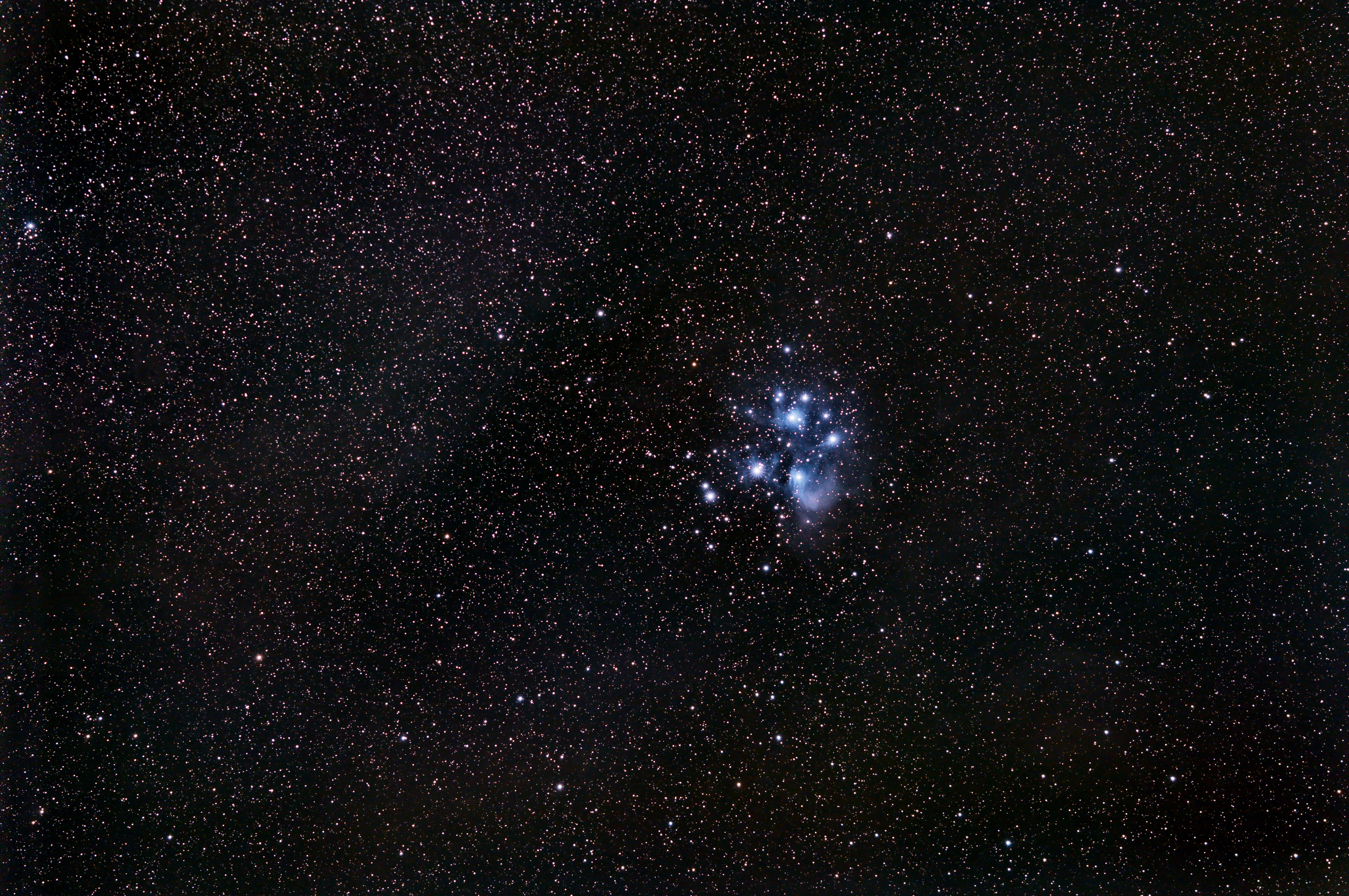
I recently used this mask before imaging the Pleiades star cluster and it helped me to achieve sharp images of the seven sisters and the faint blue reflection nebula surrounding it. An important thing to remember is that even once you’ve achieved perfect focus early on, be sure to recheck it a few times throughout your imaging session as temperatures change during the night. Also, don’t forget to take the mask off before you begin you begin imaging. I may or may not have left it on once which led to some beautifully sharp stars with three spikes shooting through them. It was quite a unique picture, but not exactly what I was going for.
If you’ve used or are looking to buy a Bahtinov mask, please let me know how this brilliantly simple invention has worked for you or any questions you may have about it in the comment section below. Thank you all so much for your support and clear skies from Late Night Astronomy.
I’ll walk you through the best views of the Moon, Planets and Deep Sky objects like the Orion Nebula this winter. Regardless of your equipment or experience, we’ve got something here for you to see in the night sky. Please let me know what you’ve gone out see this winter with your telescope, binoculars or just the naked eye in the comment section below.
I’ll show you how find the Christmas Tree Star Cluster in the night sky. Made up of over 80 stars, it lights up the sky all winter long and is a treat to see through the telescope or image with a tracking mount.
As the great conjunction approaches I’ve got a live stream of Jupiter and Saturn getting closer and closer through my telescope. How are you planning on seeing this great event on December 21st.
Don’t miss the greatest meteor shower of 2020! In this video, I’ll show you how to see the Geminids and give some tips on ways to increase the number of meteors you can see! Be sure to let me know about your experience with the Geminid Meteor Shower in the comment section below. Clear skies everyone!
I’ll show you how to see the Great Conjunction of Jupiter and Saturn, also known as “The Christmas Star”. This rare event will be an incredible experience in astronomy that you won’t want to miss!